For nearly
a decade, the Unified Payments Interface, or UPI, has been presented as one
of India's greatest digital public infrastructure success stories.
That
description is justified.
In financial year 2025-26, UPI processed around 24,162 crore transactions worth approximately ₹314 lakh crore. It has become the dominant retail digital payment system in India and has also received international recognition as the world's largest real-time payment system by transaction volume.
For millions of Indians, this has changed everyday life. We no longer have to think about whether we are carrying ₹500 or ₹2,000 in our wallets. We scan a QR code. A shopkeeper does not need an expensive card terminal. A customer does not need a credit card. Money moves directly from one bank account to another.
That simplicity is exactly why the decision to introduce a Merchant Discount Rate, or MDR, on certain UPI payments deserves careful examination.
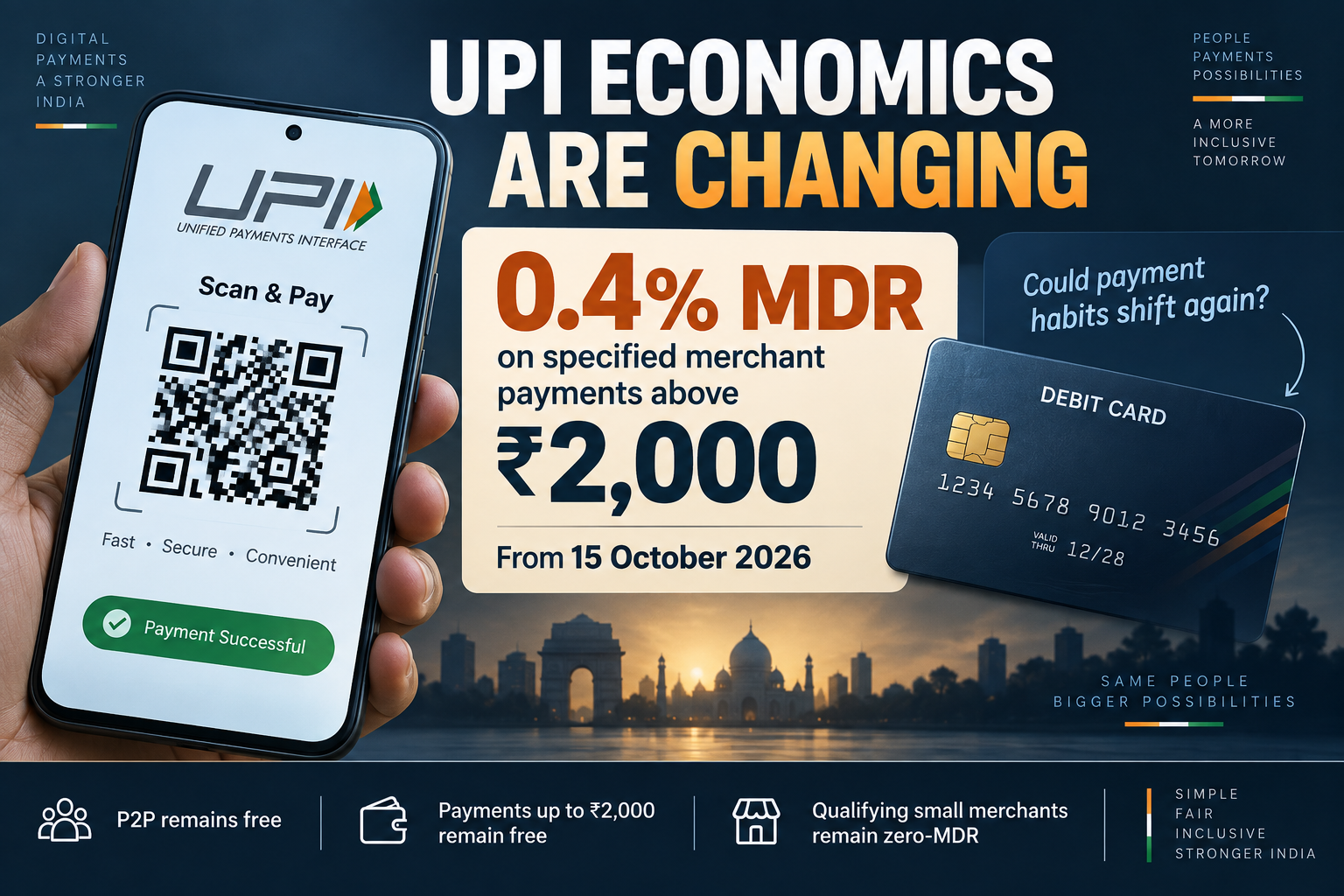
From 15 October 2026, specified person-to-merchant UPI transactions above ₹2,000 will attract an MDR of 0.4 per cent. The charge is capped at ₹300 for transactions of ₹75,000 and above. Person-to-person transfers remain free. Small merchants covered by the exemption also remain protected, while certain essential sectors will have lower fixed charges.
The Government emphasises that customers themselves will not be charged. Technically, that is correct.
Economically, the issue is considerably more
complicated.
The "only 4 per cent" argument hides the most important number
One of the strongest arguments in defence of the
policy is that approximately 96 per cent of merchant UPI transactions will
remain free.
That sounds reassuring.
But transaction count and transaction value are two
very different things.
Payments above ₹2,000 represent only around 4 per
cent of merchant UPI transactions by number, but they account for roughly two-thirds
of merchant UPI transaction value.
That changes the picture completely.
Imagine a supermarket processing 10,000 UPI
payments. Most may be relatively small purchases. But the smaller number of
customers spending ₹3,000, ₹5,000, ₹10,000 or ₹20,000 may represent a very
large share of the actual money flowing through the business.
So saying that 96 per cent of transactions remain free may be mathematically correct while still giving an incomplete picture of the economic effect.
The new MDR is concentrated on the transactions where a large part of the value of merchant UPI payments is located.
That is not a minor detail. It is central to understanding the policy.
Comparing UPI with credit cards misses an important distinction
Another argument is that merchants already pay MDR
when customers use credit cards, so imposing a smaller MDR on UPI should not be
controversial.
The comparison is not entirely unreasonable because both systems have infrastructure costs.
But they are fundamentally different financial products. A credit card provides access to a pre-approved line of credit. The card issuer pays the merchant and the cardholder repays the issuer later, subject to the terms of the credit arrangement.
In other words, credit cards combine a payment mechanism with a lending product. Ordinary bank-account UPI does not.
When I pay ₹10,000 through UPI from my savings account, I am not borrowing ₹10,000 from Google Pay, PhonePe, NPCI or my bank.
It is already my money.
It moves directly from my bank account to the merchant's bank account.
This does not mean that UPI costs nothing to
operate.
Banks need servers, cybersecurity systems, fraud-prevention mechanisms, dispute-resolution infrastructure, and technical staff. NPCI has enormous infrastructure responsibilities. Payment applications also have significant technology and customer-support expenses.
Those costs are real.
But simply saying that credit cards have MDR and therefore UPI should also have MDR avoids the larger question.
Credit-card MDR exists within the economics of a credit product involving credit risk, card issuance, lending limits, settlement arrangements and sometimes rewards and interest-free credit periods.
UPI was designed differently.
That difference was part of its success.
I have already paid tax on this money. Why should spending it attract another
toll?
There is another argument that ordinary taxpayers
instinctively understand.
Suppose someone earns ₹100.
Income tax may already have been paid on that
income.
When the remaining money is spent, GST may be
collected on the goods or services being purchased.
Now another cost is introduced into the payment chain because the customer chooses to transfer his or her own money electronically to a merchant.
Legally, MDR is not a tax. The Government is correct on that point.
MDR is a payment-processing charge distributed among participants in the payment ecosystem. It is not deposited into the Consolidated Fund as tax revenue, and the Government has specifically stated that it is neither a tax nor a charge collected by the Government or NPCI.
But legal classification is only one part of the discussion.
Economically, if a merchant has to pay 0.4 per cent whenever a qualifying UPI payment is received, that payment becomes another cost of doing business.
And businesses ultimately recover their costs somehow.
They can increase prices.
They can reduce discounts.
They can favour cash payments.
They can discourage UPI for larger purchases.
They can absorb the cost temporarily and later
adjust their margins.
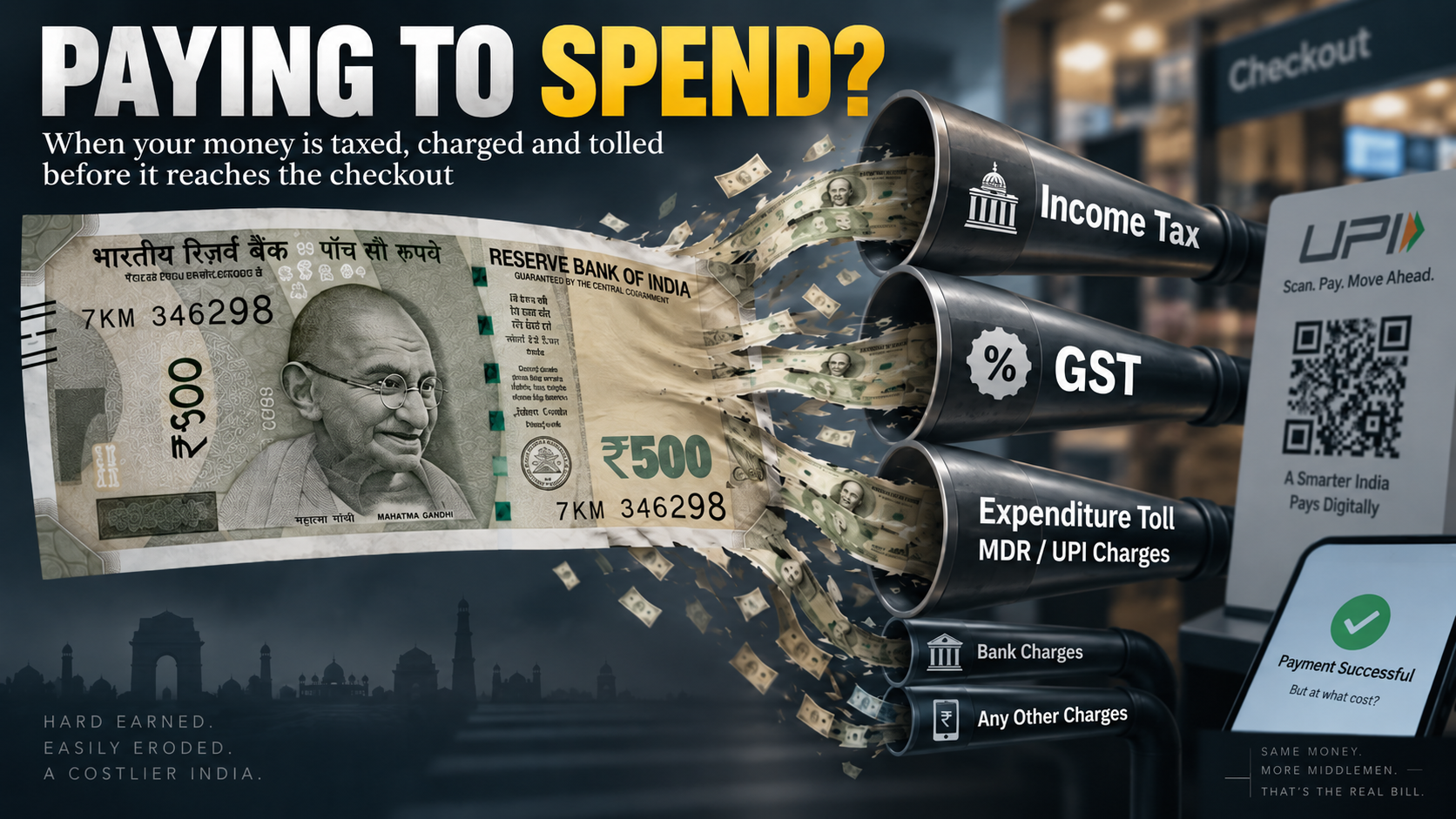
So while MDR should not be incorrectly described as a government tax, consumers may reasonably experience it as something resembling an Expenditure Toll.
The Government says the merchant will pay.
Economics asks a different question: Who will eventually bear the cost?
Those two answers are not necessarily the same.
A ₹10,000 transaction explains the issue
Take a simple example.
A customer purchases goods worth ₹10,000 and pays
through UPI.
At an MDR of 0.4 per cent, the merchant pays ₹40.
The amount appears small.
But retailers do not process one transaction.
A business receiving ₹1 crore through eligible transactions would face ₹40,000 in MDR before considering exemptions and transaction caps.
At ₹10 crore, the theoretical percentage cost
becomes ₹4 lakh.
At ₹100 crore, it becomes ₹40 lakh, again subject
to applicable caps and exemptions.
These are operating expenses.
For a business with very thin margins, 0.4 per cent
of turnover can be much more significant than 0.4 per cent sounds.
A retailer earning a net margin of 3 per cent is
operating under very different economics from a company earning margins of 30
or 40 per cent.
That is why percentage charges on turnover deserve
careful examination.
The strongest question: who is actually losing money because UPI is free?
This leads to perhaps the most important part of the debate.
Supporters of MDR correctly point out that running UPI costs money.
Recent estimates put the annual cost of the wider
UPI ecosystem at around ₹20,000 crore, while the Government's incentive
allocation has been far lower. Government officials have therefore argued that
the present model places too much dependence on subsidy and does not provide
sufficient commercial incentive for smaller payment companies to compete.
That argument deserves to be taken seriously.
But another set of numbers deserves equal
attention.
RBI is not running at a loss
For financial year 2025-26, the Reserve Bank of India approved a record ₹2,86,588 crore surplus transfer to the Central Government.
That is approximately US$30 billion.
RBI's gross income increased substantially during the year and its balance sheet expanded to around ₹91.97 lakh crore.
This does not mean that RBI's surplus was generated by UPI. It was not.
RBI earns income from several sources, including foreign assets, government securities and foreign-exchange operations.
But the important point is that India's central bank is not an institution facing financial distress because digital payments remain free.
It transferred nearly ₹2.87 lakh crore of surplus to the Government in a single year.
The banking industry is also reporting record profits
The commercial banking system presents a similar picture.
Listed commercial banks reported a combined consolidated net profit of approximately ₹4.11 lakh crore in FY 2025-26.
Public-sector banks alone earned a record ₹1.98 lakh crore in net profit, while their aggregate operating profit reached ₹3.21 lakh crore.
Again, this does not prove that UPI itself
generates profits for every bank.
Banks make money from lending, investments, fees,
treasury operations and many other activities.
UPI processing can certainly create costs for them.
But the claim that banks need MDR because the banking system as a whole is being financially damaged by free UPI requires much more evidence than simply stating that processing payments costs money.
The banks participating in UPI are not, as a group, loss-making institutions. They are recording some of the largest profits in Indian banking history.
NPCI itself remains profitable
Then there is NPCI.
NPCI is a not-for-profit organisation, so it
generally describes its earnings as surplus rather than conventional corporate
profit.
Its latest reported FY 2025-26 financial numbers show a standalone net surplus of approximately ₹1,362 crore, despite higher expenditure on marketing, depreciation, administration and server infrastructure.
Its standalone operating revenue rose to approximately ₹3,969 crore during the year.
NPCI had also reported a net surplus of about ₹1,552 crore in the previous financial year.
In other words, the organisation at the heart of India's retail payment infrastructure is not operating at an overall financial loss either.
If the case for MDR is that the zero-MDR UPI model has become financially unsustainable, then the public deserves to see the numbers.
® How much does UPI actually cost NPCI?
® How much do issuing banks spend?
® How much do acquiring banks spend?
® How much do payment service providers spend?
® How much of the estimated ₹20,000 crore represents direct
transaction-processing costs, and how much represents marketing, cashback,
customer acquisition, expansion or other commercial expenditure?
® And after existing revenues, cross-selling benefits and government
incentives are included, what is the actual funding gap?
These are reasonable questions.
Because we now have a curious situation.
The RBI is transferring nearly ₹2.87 lakh crore of surplus to the Government. Commercial banks are reporting more than ₹4 lakh crore of annual profits. NPCI itself continues to record a substantial surplus. Yet one of the world's most successful digital payment systems is being told that its existing free model is no longer sustainable.
That does not automatically prove that MDR is unnecessary. But it certainly means that the case for imposing MDR should be demonstrated with detailed figures rather than asserted as an inevitability.
Do not destroy the feature that made UPI successful
UPI has not merely become successful in India.
It has become part of India's international
technological reputation.
Its extraordinary scale has attracted attention
around the world.
India processed about ₹314 lakh crore through UPI
in FY 2025-26. By August 2026 alone, monthly UPI volume had reached more than
24.5 billion transactions.
One of the fundamental reasons for that success was
simplicity.
Scan Pay
Done.
Neither the customer nor the ordinary merchant had to stop and calculate the cost of the payment method. Introducing a toll into a system that succeeded partly because there was no toll therefore deserves caution.
The question should not merely be:
Does UPI cost money to operate?
Of course it does.
The correct questions are:
How much does it actually cost?
Who currently bears that cost?
Who benefits financially from the enormous
ecosystem UPI has created?
And is a percentage charge on merchant transactions
really the most efficient way to finance it?
A highly successful system should not be changed
simply because a new revenue stream has become possible.
"Merchants cannot pass it on" is easier to announce than enforce
The Government has said the MDR should not be
passed directly to customers and has indicated that merchant behaviour will be
monitored.
That may prevent the most obvious form of
surcharge.
A merchant should not be able to say:
"₹10,000 plus ₹40 UPI fee."
But indirect recovery is much harder to regulate.
Money is fungible.
Once a new expense enters a business, it becomes
almost impossible for a regulator to identify precisely how that expense has
affected prices.
That is why saying "the merchant pays, not the customer" does not settle the issue. The legal incidence of a charge and its economic incidence are different things.
The biggest danger is a return towards cash
India has spent years encouraging citizens and
businesses to move away from cash. There were good reasons for doing so. Digital
transactions create records. They make accounting easier. They reduce the risks
associated with storing and transporting physical currency. They can improve
transparency. They can help small businesses create financial histories that
may later support access to formal credit.
UPI accelerated that transition because it removed one of the traditional disadvantages of electronic payments: transaction cost.
When a customer transferred ₹10,000, the merchant received ₹10,000.
That simplicity mattered.
Under MDR, the calculation changes.
For businesses operating on thin margins, cash can
begin to look attractive again.
Retail groups have already raised concerns that transaction charges could encourage some merchants to return to cash for larger transactions.
That would create a strange policy contradiction.
India spent years encouraging digital payments. The country built one of the most successful digital payment systems anywhere in the world.
Then, after merchants and consumers changed their
behaviour, the economics of using that system changed. Putting a restraint now would
be a step backwards.
And moving back to cash does not necessarily mean escaping charges
Cash itself is not completely free within the banking system. Banks levy charges for certain ATM transactions beyond prescribed free limits and can impose various service charges according to account type and banking arrangements. Customers may also face debit-card annual charges, cheque-book charges, account-maintenance charges and other banking fees depending on the institution and type of account. Banks levy cash deposits after a certain number of deposits and a certain amount deposited per transaction.
It is important to be accurate here.
These charges are not all fixed personally by the
Union Government.
Banks have regulatory freedom over many service
charges.
But from the customer's perspective, the
distinction may matter less than policymakers imagine.
The consumer experiences the total cost of
accessing and using his or her money.
If cash withdrawals cost money beyond certain
limits, cash deposits cost money, cards carry annual fees, cheque leaves carry
charges, account services carry charges, and larger digital merchant payments
also begin generating transaction costs, customers can reasonably ask where the
genuinely low-cost method of spending their own money remains.
Individually, every charge can be defended.
Collectively, they create a system in which access
to money appears surrounded by small toll gates.
What about the UPI subsidy?
Government support for UPI has existed because policymakers recognised that digital payments generate wider benefits beyond the companies directly processing transactions.
A digital transaction leaves an audit trail.
It helps formalise commerce.
It reduces dependence on physical cash.
It can improve financial inclusion.
It creates data that may help legitimate businesses
establish credit histories.
These are public benefits.
That is why describing government support for UPI simply as a commercial "subsidy" can be misleading.
Public money is routinely spent on infrastructure because the wider economic benefit exceeds the direct financial return.
Roads cost money.
Railways cost money.
Digital identity infrastructure costs money.
Payment infrastructure also costs money.
The correct question is whether the social and
economic return from keeping UPI frictionless is worth the public expenditure
involved.
The same precision is necessary when discussing bank write-offs
Large bank loan write-offs and loan waivers are also frequently raised in this debate. Large loan write-offs and recoveries do raise legitimate questions about how financial institutions allocate costs, absorb losses and price services for ordinary customers.
Those questions become especially relevant when customers and small businesses are told that additional payment charges are necessary for financial sustainability.
The question policymakers should answer
The Government's argument is that UPI infrastructure must become financially sustainable. That objective is reasonable.
But financial sustainability does not automatically require a percentage charge on merchant payments.
Before altering a system of this scale, the public deserves transparent answers.
What is the exact cost of operating UPI?
How much is borne by banks?
How much is borne by NPCI?
How much is borne by payment applications?
How much is genuine transaction-processing cost?
How much is marketing and customer acquisition?
How much revenue do participants already earn
indirectly because UPI brings customers into their financial ecosystems?
What portion of the ₹20,000 crore estimated
ecosystem cost represents an actual funding deficit?
And why is 0.4 per cent MDR superior to the other
possible financing models?
These questions become particularly important
because the institutions involved are not collectively displaying signs of
financial collapse.
Do not lose sight of what India has built
UPI is not merely another payment product.
It has become part of India's economic
infrastructure.
A vegetable seller uses it.
A taxi driver uses it.
A multinational retailer uses it.
A student uses it.
A pensioner uses it.
Families use it to transfer money.
Businesses use it to receive payments.
Ordinary investors use it to invest in markets.
People use it to fuel their vehicles at Fuel Pumps.
It has become almost as ordinary as cash while
remaining more traceable, auditable and efficient.
That achievement took years to build.
The cost of maintaining UPI must certainly be paid
by somebody.
Pretending otherwise would be unrealistic.
But policymakers should be equally careful about
assuming that the solution must be another percentage charge between a merchant
and money arriving electronically from a customer's bank account.
Merchant costs influence prices.
Prices influence customers.
Payment costs influence merchant behaviour.
And merchant behaviour will determine whether
India's economy continues moving towards digital transactions or begins
rediscovering cash.
The most important question is therefore not:
"Will customers see a separate UPI charge on
their screens?"
The important question is:
"Will the new system make digital commerce
more expensive than it was before?"
If it does, even indirectly, policymakers will need to weigh that cost against the revenue and investment that MDR is expected to generate.
India has created a payment system admired across the world.
Any change to its economics should therefore pass a
very high test.
The objective should not merely be to find a way to
monetise UPI.
It should be to preserve the simplicity, universality and low friction that made UPI successful in the first place.

Discussion
Well written