In this article
- How the Bengal SIR reached this point
- What the 38.31 lakh appeals actually mean
- The most consequential number may be 1,607
- Did the SIR determine the Bengal election?
- The case for rigorous electoral-roll revision
- An Equidynamist reading of the problem
- The information that is still missing
- The tribunal backlog raises another question
- Electoral integrity begins before a vote is cast
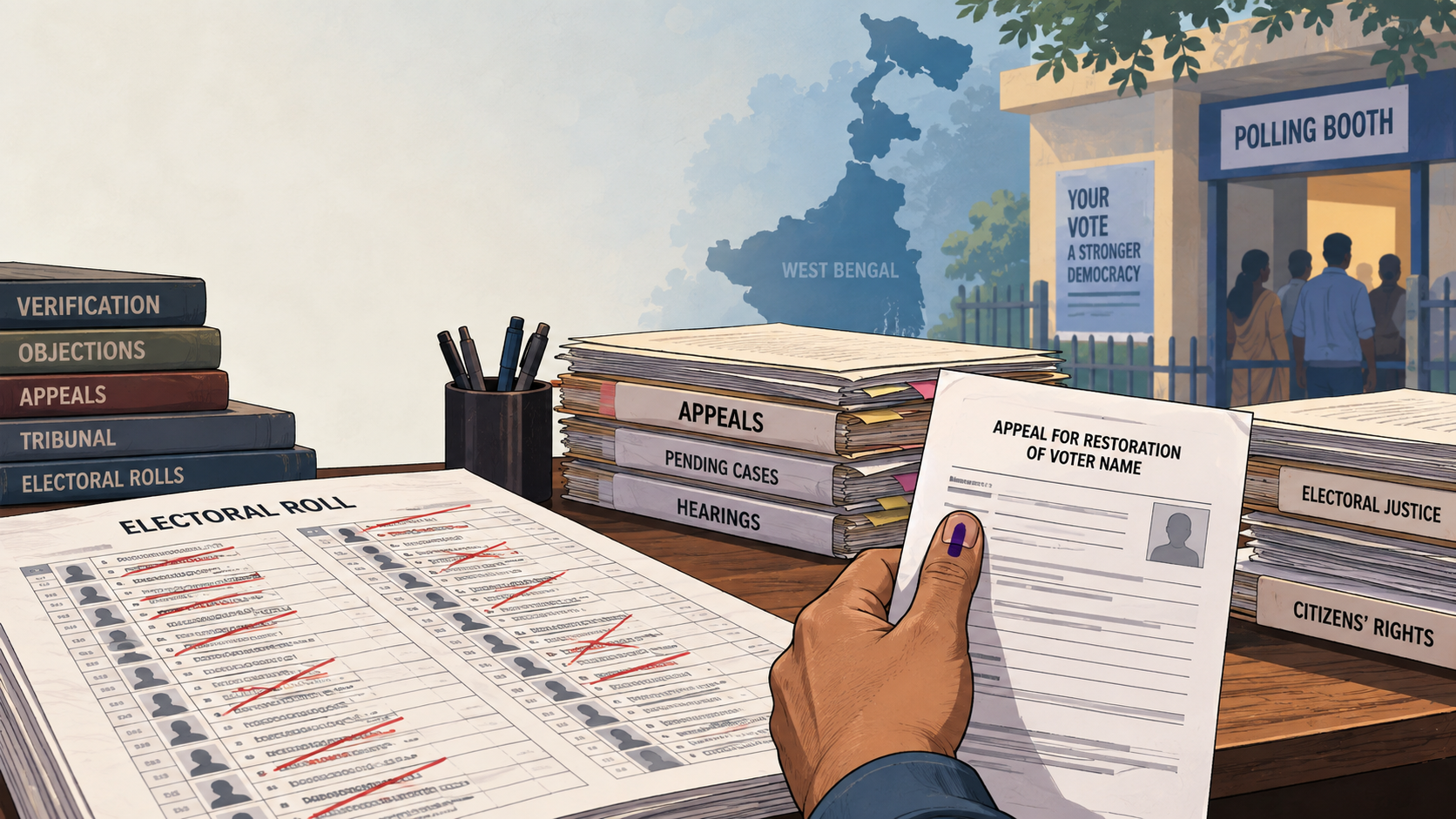
Nearly five months after West Bengal voted, a remarkable number has entered the public record. The Election Commission has informed the Supreme Court that 22.21 lakh of the 27.16 lakh electors deleted following adjudication of Special Intensive Revision, or SIR, "logical discrepancy" cases appealed against their exclusion. That works out to about 82 per cent.
The figure does not come from a political party, an activist organisation or a
social media calculation. It comes from the Election Commission's own
submission before the Supreme Court. But its significance must also be
understood carefully. It does not establish that all those deletions were
wrongful, nor does it prove that every appellant was an eligible voter. An
appeal establishes that the decision was disputed. Whether the original
decision was right or wrong can only be determined through adjudication.
The real democratic issue lies elsewhere. When such a large proportion
of deleted electors challenge their exclusion and their appeals cannot be
resolved before polling, the issue becomes one of timing and due process.
Electoral remedies operate differently from many other administrative remedies
because a vote lost in an election cannot be restored retrospectively.
How the Bengal SIR reached this point
The West Bengal SIR became unusually complicated because of what the
Election Commission termed "logical discrepancies" in electoral
records. These included various inconsistencies involving names, ages,
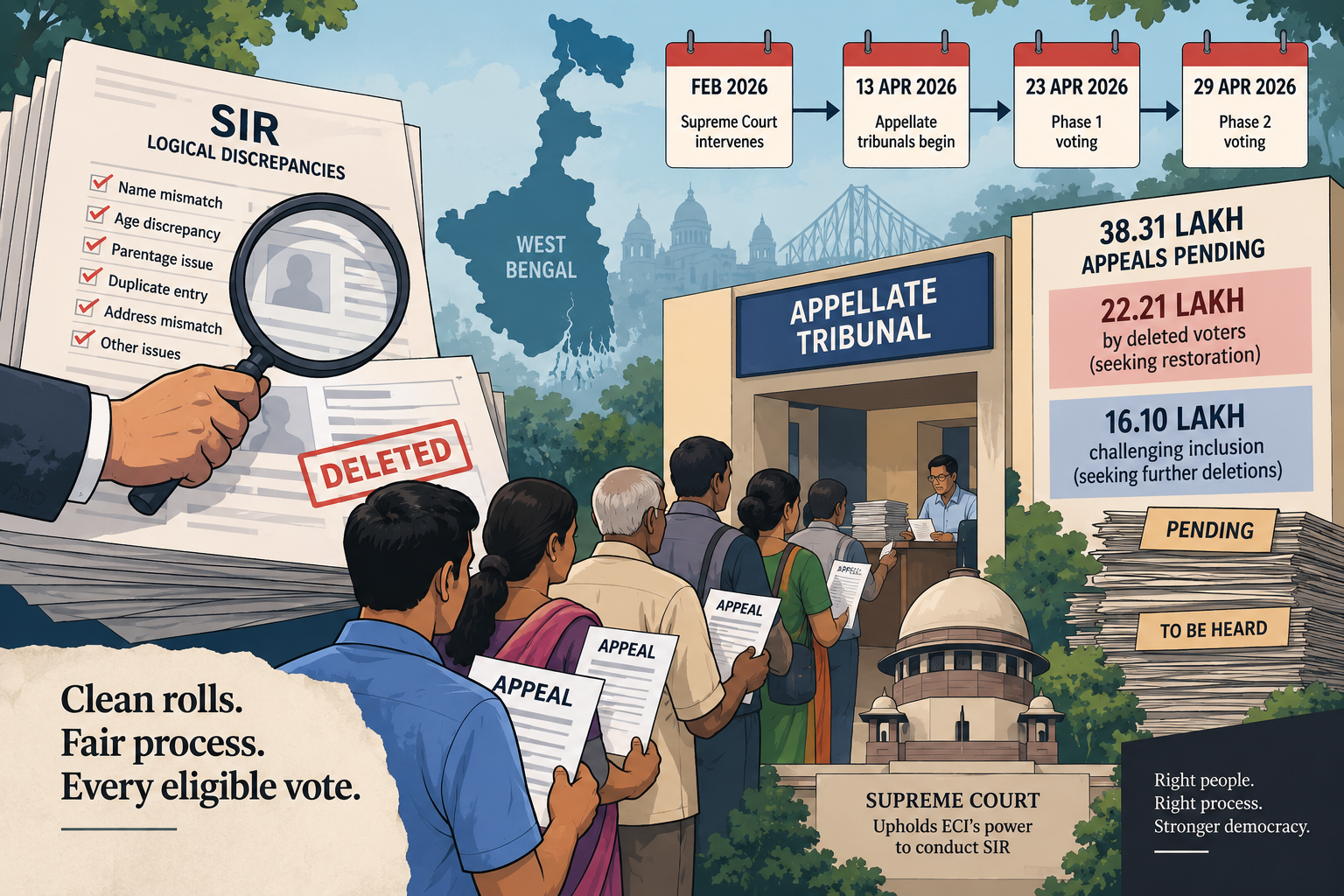
parentage and other information. In February 2026, the Supreme Court intervened
amid what it described as a "trust deficit" between the Election
Commission and the then West Bengal government.
Around 700 judicial officers from West Bengal, Jharkhand and Odisha
were eventually tasked with determining the eligibility of approximately 60.06
lakh electors flagged through this process. Of these, 27.16 lakh names were
ordered to be deleted, while the remaining electors were retained. The Supreme
Court subsequently directed the establishment of appellate tribunals to hear
challenges to these decisions.
Nineteen tribunals began functioning on 13 April 2026. West Bengal went
to the polls in two phases on 23 April and 29 April. The appellate mechanism
therefore became operational only ten days before the first phase and sixteen
days before the second.
That narrow window is central to the controversy.
What the 38.31 lakh appeals actually mean
One source of confusion in the public debate has been the repeated use
of the figure of roughly 38 lakh appeals without distinguishing between
different kinds of cases.
The Election Commission has now clarified that 38.31 lakh appeals were
pending before the appellate tribunals. Of these, 22.21 lakh were filed by
deleted electors seeking restoration of their names. Another 16.10 lakh
challenged the inclusion of people who had remained on the electoral rolls and
therefore sought further deletions. The Commission did not identify who had
filed those challenges, although electoral law permits electors and electoral
officials to seek deletion of persons alleged to be ineligible.
The distinction matters because the entire pool of pending cases cannot
accurately be described as appeals by deleted voters.
Equally important is what the restoration appeals do not establish. A
voter who was properly excluded may appeal, just as a voter who was wrongly
excluded may appeal. Treating every appeal as proof of wrongful deletion would
therefore be misleading. But treating every original deletion as conclusive
proof of ineligibility would be equally problematic, because the very existence
of an appellate process recognises that initial decisions can be challenged and
reversed.
The most consequential number may be 1,607
According to the Election Commission's disclosure reported by The
Indian Express, only 1,607 deleted electors were restored to the rolls in time
to participate in the April Assembly election.
This does not mean that all the other restoration appeals were rejected. That
conclusion would be mathematically and legally incorrect because large numbers
of cases remained unresolved. The problem is precisely that adjudication had
not been completed.
If an appellate tribunal eventually concludes that someone should have
remained on the electoral roll, restoring that person's name months after
polling does not restore the opportunity to participate in the election that
has already taken place. There is no retrospective ballot.
This gives electoral due process an unavoidable temporal dimension. A
remedy can be legally available yet practically ineffective for a particular
election if it arrives after polling.
What the Supreme Court has already decided
Any examination of the controversy must also acknowledge the Supreme
Court's May 2026 judgment concerning the Election Commission's authority to
conduct SIR.
On 27 May, the Court upheld the legal power of the Election Commission
to undertake Special Intensive Revision and held that such revision has a
direct connection with maintaining accurate electoral rolls and ensuring free
and fair elections. It rejected the broader argument that the Commission lacked
the constitutional and statutory authority to conduct such an exercise.
That significantly narrows the present debate. The central question is
no longer simply whether the Election Commission possesses the power to
undertake an intensive revision. The Court has answered that legal question.
The unresolved issue is how that power was implemented in individual
cases and whether the institutional machinery provided enough time to correct
erroneous decisions before voting.
Legal authority to conduct revision and the accuracy of every decision made
during that revision are separate questions. An administrative process can be
lawful while individual decisions produced within it remain subject to appeal.
Did the SIR determine the Bengal election?
This is where evidence must take precedence over political assumption.
The Election Commission's published result page recorded the BJP
winning 207 constituencies and the All India Trinamool Congress winning 80
among the results then declared. Former Chief Minister Mamata Banerjee and
other TMC leaders alleged that the electoral-roll process helped the BJP, while
the BJP rejected such allegations and maintained that the result represented
the voters' verdict.
The existence of mass restoration appeals cannot establish how those
electors would have voted. There is no credible basis for assigning them
collectively to the TMC, BJP, Congress, Left or any other party. Some might
also have chosen not to vote.
Nor can a statewide vote difference by itself answer the question.
Assembly elections are decided constituency by constituency. Any serious
attempt to examine whether exclusions could have affected individual results
would require constituency-level information on deletions, restoration appeals,
final appellate decisions, turnout and victory margins.
Without such evidence, the claim that the SIR changed the winner of the
2026 West Bengal election remains an allegation or hypothesis rather than an
established conclusion.
The procedural question can be examined independently of that political
claim: were eligible citizens given a reasonable opportunity to establish their
eligibility before polling?
The case for rigorous electoral-roll revision
There is a legitimate case for maintaining clean electoral rolls.
Deceased voters should not remain registered. Duplicate enrolments should be
corrected. People permanently registered at the wrong address may need to be
removed from that roll, and persons who do not satisfy the legal requirements
for enrolment cannot acquire voting rights simply because their names once
appeared on a list.
The Election Commission therefore has a constitutional responsibility
not merely to conduct elections but also to maintain credible electoral rolls.
The difficulty arises because electoral integrity involves two
different kinds of error. Allowing an ineligible person to remain on the roll
compromises the integrity of the system. Removing an eligible citizen
compromises it as well.
The institutional objective cannot therefore be measured by how many
names are deleted or how many are retained. The relevant measure is whether
eligible electors are correctly included and ineligible entries are correctly
excluded, with sufficient safeguards to correct mistakes before they become
irreversible for an election.
An Equidynamist reading of the problem
The controversy provides a useful example of the kind of institutional
tension that Equidynamism attempts to address.
The competing principles here are electoral integrity and democratic
inclusion. Neither can simply be sacrificed in favour of the other.
A system that concentrates exclusively on preventing wrongful inclusion
risks wrongful exclusion. A system designed only to prevent wrongful exclusion
may make it harder to remove entries that should not remain on the rolls.
Dynamic equilibrium requires institutional mechanisms capable of
pursuing both objectives simultaneously. Verification must be rigorous enough
to protect the credibility of the roll, while the notice, hearing and appellate
processes must be fast and accessible enough to protect legitimate electors.
Seen in that way, the quality of an electoral revision should be judged
not by the scale of the exercise but by the accuracy and timeliness of its
final outcomes.
The information that is still missing
The next stage of this debate needs data rather than competing
political narratives.
Constituency-level figures showing how many electors were flagged,
deleted, retained, appealed, restored or finally rejected would allow the
public to understand the scale and distribution of the problem. Aggregate
reason codes would also be valuable. They could show how many exclusions arose
from age inconsistencies, name discrepancies, parentage records, addresses,
duplication, citizenship-related questions or other grounds.
Most importantly, final appellate outcomes need to become available.
Those outcomes could substantially change how the original deletion
process is assessed. If the overwhelming majority of appeals are eventually
dismissed after full adjudication, that would provide evidence supporting the
reliability of many initial decisions. If substantial numbers are allowed, that
would provide evidence of significant error in the earlier process.
At present, neither conclusion can responsibly be assumed.
For future large-scale revisions, one institutional question also
deserves consideration: whether an extraordinary revision process should
proceed into polling while a very large number of eligibility disputes remain
undecided, particularly when the delay is not attributable to the voter.
The tribunal backlog raises another question
The Election Commission has proposed increasing the number of appellate
tribunals in West Bengal so that their number corresponds with the state's
parliamentary constituencies, with the objective of accelerating disposal of
pending cases.
That proposal raises an administrative-capacity question. If more
tribunals are now considered necessary to process the backlog efficiently, it
is reasonable to examine whether nineteen tribunals were adequate when millions
of cases had to be addressed around the time of an approaching Assembly
election.
This need not be framed as an accusation. It is a question of whether
the available adjudicatory capacity matched the scale and urgency of the task.
Electoral integrity begins before a vote is cast
India devotes enormous institutional attention to EVM security, polling
booths, ballot secrecy, counting procedures and result certification. All of
these are essential.
But accurate counting protects only votes that were actually cast.
Electoral integrity also depends on whether eligible citizens were able to
reach that stage.
The newly disclosed appeal figures therefore deserve examination
without exaggeration and without dismissal. They do not establish mass wrongful
deletion, election theft or a different hypothetical winner. They establish
something more limited but still significant: an exceptionally large body of
deletion decisions was formally contested, while the electoral calendar moved
ahead before the appellate process could resolve most of those disputes.
Ultimately, credible elections require both sides of electoral-roll
integrity to function together. Ineligible entries must be removed, and
eligible citizens must have a meaningful opportunity to remain on the roll
before their opportunity to vote disappears.
Ask Arka about what you just read
Ask for a summary, clarification, the evidence behind an argument, or more writing by Anindya on the same subject.



Discussion