In this article
- Before Fingerprints Could Identify Anyone, Someone Had to Solve the Filing Problem
- Azizul Haque and the Mathematics Behind the System
- Hem Chandra Bose Did Not Merely Assist. He Continued Innovating
- Then Why Is It Called the Henry Classification System?
- Haque Eventually Had to Ask
- Haque's Recognition Opened the Door for Bose
- December 1929: Recognition Was Approved, but Bose Needed the Money to Survive
- A System Built to Recover Lost Identities Nearly Lost Its Own Creators
- This Was About More Than Two Forgotten Scientists
- Giving Henry His Place Without Taking Away Haque and Bose's
- Why Their Story Matters in India Today
- How do we reliably find one identity among millions?
There is a particularly cruel irony in the story of Qazi Azizul Haque and Hem Chandra Bose.
These two Indian police officers helped develop a system whose entire
purpose was to prevent human identity from being lost. Their work made it
possible to take thousands, eventually millions, of fingerprint records and
arrange them in such a way that one person could be found among them with
remarkable speed and certainty.
Yet for decades, the identities of the men who performed much of that
work were themselves pushed towards the margins of history.
The system became famous across the world as the Henry
Classification System, named after their British superior, Edward Richard
Henry. Henry went on to become Commissioner of the Metropolitan Police in
London and one of the internationally recognised figures associated with
fingerprint identification. Haque and Bose remained comparatively obscure
Indian officers whose contribution had to be reconstructed from government
files, correspondence and later historical research.¹
The imbalance was not merely an accident of historical memory. It
emerged from the institutional structure within which they worked. They were
Indian subordinate officers in the police establishment of the British Raj.
Henry was the British Inspector-General of Police in Bengal. When the work
travelled from Calcutta to official committees, scientific meetings and
publications in Britain, it was Henry who possessed the rank, position and
institutional authority to present it.
The technical work might be done in Calcutta. The public authorship
could still belong in London.
That distinction lies at the heart of this story.


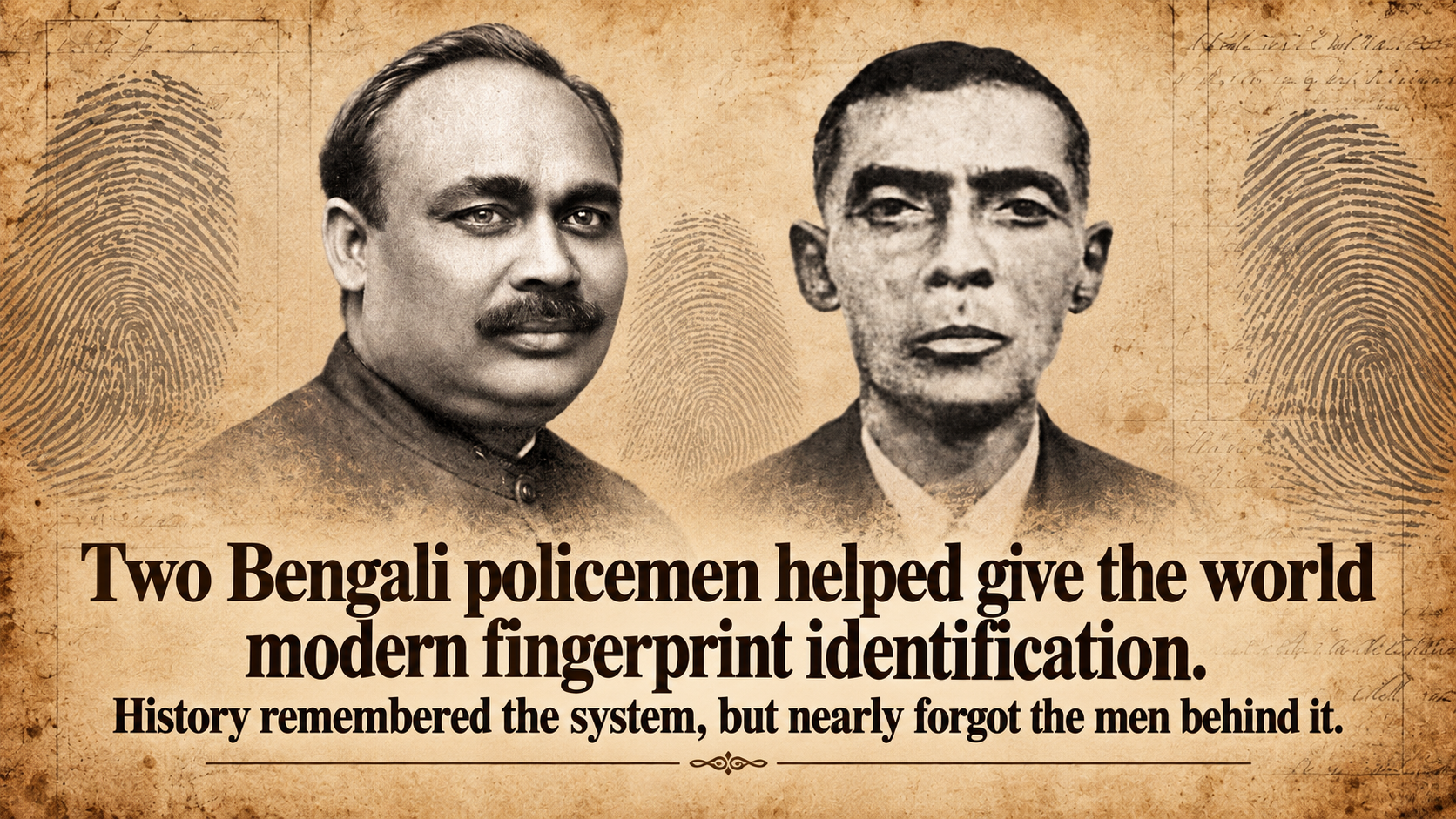
Qazi Azizul Haque and Hem Chandra Bose, the two Indian police officers whose work was fundamental to the development of modern fingerprint classification. Both photographs are historical images of the actual officers.
Before Fingerprints Could Identify Anyone, Someone Had to Solve the Filing Problem
The importance of Haque and Bose becomes clearer when we understand
what the real problem was.
By the late nineteenth century, it was increasingly understood that
fingerprints could distinguish one person from another. Francis Galton had
published important work demonstrating the permanence and individuality of
fingerprint patterns. But recognising that fingerprints were unique was not the
same thing as creating a practical police identification system.
Suppose a police department possessed ten fingerprint cards. Comparing
a new set manually would be easy.
Suppose it possessed one hundred.
Or ten thousand.
Or one hundred thousand.
The difficulty was not merely collecting fingerprints. The difficult
problem was retrieval.
How could thousands of fingerprint records be classified so that
investigators receiving a new set of prints could rapidly narrow the search
instead of comparing every card individually?
That was the problem being tackled in Bengal.
In 1897, after a committee examined fingerprinting against the existing
anthropometric system, the Government of India approved fingerprint
classification for criminal records. The Anthropometric Bureau in Calcutta
consequently developed into what is widely described as the world's first
fingerprint bureau. Haque and Bose were central figures in this work.²
The solution that emerged would eventually become known worldwide as
the Henry Classification System.
But the surviving record makes clear that Henry was not working alone.
Azizul Haque and the Mathematics Behind the System
Qazi Azizul Haque, born in Bengal in about 1872, possessed an
exceptional aptitude for mathematics. He eventually joined the Bengal Police
and became associated with the fingerprint classification work being conducted
under Henry. Historical accounts and later government correspondence identify
Haque's mathematical contribution as especially important to the primary
classification of fingerprints.³
The central achievement was to transform fingerprint characteristics
into an ordered classification that could be placed into searchable groups.
This sounds almost mundane today because databases perform such
searches electronically. In the 1890s, however, there were no computers.
Classification had to be designed so that physical fingerprint cards could be
placed into appropriate compartments and an investigator could progressively
narrow the field.
Haque developed the mathematical structure that made this possible.
In a 1925 communication, J. D. Sifton, then officiating Chief Secretary
to the Government of Bihar and Orissa, described how Haque had been allowed to
undertake research into fingerprint classification and, after months of
experimentation, had evolved the primary classification that demonstrated that
an effective filing system was possible.³
This was not simply clerical assistance.
It was the intellectual architecture that helped turn fingerprinting
from an interesting method of comparison into a system capable of operating at
institutional scale.
Modern historians of fingerprint science Gurvinder Sodhi and Jasjeet
Kaur, after examining Home Department material at the National Archives of
India, have argued that Haque and Bose played the leading role in working out
the classification formula that later carried Henry's name. Their later
research described the marginalisation of the two Indian officers as a
consequence of colonial structures and what they termed scientific racism.¹
Hem Chandra Bose Did Not Merely Assist. He Continued Innovating
Hem Chandra Bose, born in 1867, was another Indian officer attached to
the fingerprint establishment in Calcutta. Like Haque, he worked under Henry
during the formative stage of the classification system. But Bose's importance
extends well beyond those early years.
He continued working on fingerprint methodology long after the initial
classification problem had been addressed.
Among the improvements attributed to Bose were methods involving
numerical sub-classification, indexing, imperfect impressions and the treatment
of individual fingerprints rather than only complete ten-finger sets.
Government records later specifically listed a series of improvements
introduced during his long service at the Bengal Finger Print Bureau.⁴
Then came another remarkable innovation.
Sending a Fingerprint by Telegraph
A fingerprint image could not conveniently be transmitted across India
by telegram. Bose therefore worked on a method of translating fingerprint
information into a code capable of telegraphic communication.
In 1916 he published Hints on Finger-Prints with a Telegraphic Code
for Finger Impressions. The system was reportedly being used in Bengal from
1917.⁵
The practical significance was enormous.
Imagine that a man was arrested in Bombay under an assumed name while
his criminal record existed in Calcutta. Physical fingerprint cards could
travel by post, but that took time. A coded description transmitted by telegram
could allow another fingerprint bureau to begin searching almost immediately.
Bose had therefore confronted what today would be called a problem of data
transmission and interoperability.
And he did it decades before digital networks existed.
Yet another British name later became internationally associated with
this field. Charles Stockley Collins of Scotland Yard published a fingerprint
telegraphic code in 1921, five years after Bose's publication. Historical
research based on Home Department records notes that Indian officials
themselves recognised Bose as having been first in the field with a practical
fingerprint telegraphic code.⁵
Bose went further still. In the 1920s he developed a system for the
classification of single-digit impressions, an important advance because
a crime scene does not conveniently provide investigators with all ten
fingerprints of a suspect. His work preceded comparable developments associated
with Scotland Yard.⁶
Then Why Is It Called the Henry Classification System?
That is the uncomfortable question.
Edward Richard Henry unquestionably occupied an important position in
the development and institutional adoption of fingerprint classification. He
headed the Bengal Police organisation in which the work took place, encouraged
the investigation of fingerprint methods and became the system's principal
advocate before governments and police organisations.
But that is different from saying that the detailed classification
methodology emerged from Henry alone.
When Henry appeared before the British committee investigating methods
for identifying criminals, the system was publicly associated with him. In 1899
he presented fingerprint classification in Britain. His book Classification
and Uses of Finger Prints, published in 1900, carried his name as author
and helped disseminate the method internationally.⁷
Haque and Bose did not receive corresponding prominence.
This mattered enormously because scientific memory is shaped not simply
by who works on an idea, but by whose name appears on the publication, whose
testimony enters the official record and whose identity becomes attached to the
invention.
Henry had all three advantages.
The Indian officers did not.
The hierarchy of colonial administration amplified this difference. An
Indian Sub-Inspector and a British Inspector-General did not occupy remotely
comparable positions within the bureaucracy. Historical research on colonial
policing shows that Indian subordinates increasingly performed investigation
and technical policing functions while senior command remained heavily
structured around British authority.⁸
Sodhi and Kaur put the problem more explicitly. Their examination of
the archival record concluded that an Indian subordinate officer in 1900 had
little realistic institutional avenue through which to challenge the
attribution being made by his British Inspector-General.¹
This is the colonial context that must not disappear from the story.
It is too simplistic to say that every British officer deliberately
stole every achievement made by an Indian subordinate. But it would be equally
misleading to treat the recognition gap as if Haque, Bose and Henry were three
scientists working as institutional equals.
They were not.
One belonged to the ruling colonial establishment and possessed the
authority to represent the work internationally. The other two were Indians
serving beneath him in that establishment.
When the system travelled abroad, the hierarchy travelled with it.
Haque Eventually Had to Ask
Perhaps the most revealing part of the story came decades later.
Recognition did not automatically find Azizul Haque.
Haque had received colonial titles, including Khan Bahadur, but the
specific scale of his contribution to fingerprint classification remained
inadequately recognised. In March 1925, after retirement, he submitted an
application to the Governor of Bihar and Orissa seeking a jagir, or land
grant, partly on the basis of his role in adapting fingerprint identification
to practical use.⁹
The language preserved from that petition itself tells us something
about the relationship between an Indian officer and the colonial state. Haque
repeatedly described himself in the deferential bureaucratic language expected
of a petitioner addressing imperial authority.
He also enclosed evidence supporting his claim.
A February 1925 article in The Statesman had already observed
that an Indian Muslim Sub-Inspector had played an important but insufficiently
acknowledged role in fingerprint classification.⁹
The Government of Bihar and Orissa considered his request
sympathetically but could not provide the requested land. His case therefore
moved upward through government channels.
And then something extraordinary happened.
The bureaucracy eventually sought the opinion of Edward Henry himself.
In other words, decades after contributing to the system, Haque's
recognition still depended substantially upon confirmation from the British
superior whose name had already become attached to that system.
Henry's response was significant.
He stated that Haque had contributed “more than any other member of
my staff” to perfecting the classification system.¹⁰
Those few words fundamentally changed the historical record.
The Government of India ultimately sanctioned an honorarium of ₹5,000
for Haque in 1926. Government material acknowledged him as Henry's principal
helper and recognised that he had made a major contribution to the
classification method that had acquired worldwide importance.¹¹
But consider what had been required.
The work had been done in the 1890s.
The worldwide system already carried Henry's name.
Haque had reached retirement.
He had to petition.
The matter had to move through the colonial bureaucracy.
And finally, the testimony of the British superior was required to
establish before the government the importance of work that Haque himself had
performed roughly three decades earlier.
That is not merely delayed recognition.
It is an illustration of how colonial authority determined who was
considered capable of authoritatively validating achievement.
Haque's Recognition Opened the Door for Bose
Hem Chandra Bose's case followed.
By this time there was an important precedent. If Haque could receive a
monetary award for his contribution to fingerprint science, the Bengal
Government had grounds to seek similar recognition for Bose.
The record supporting Bose was substantial.
The Government of Bengal documented his improvements to fingerprint
sub-classification and indexing, his telegraphic code and his work on
single-finger classification. Officials noted that his innovations had proved
useful not merely in India but internationally.⁴
The Bengal authorities initially proposed an honorarium of ₹10,000.
The Government of India objected to that amount.
One reason was striking. Since Henry had previously stated that Haque
contributed more than any other member of his staff, officials reasoned that
Bose should not receive an award larger than the ₹5,000 given to Haque.⁹
Once again Henry's assessment remained influential.
When asked about Bose, Henry acknowledged that Bose had spent his
career perfecting methods that made fingerprint searching easier and deserved
considerable credit.
The Standing Finance Committee eventually sanctioned ₹5,000 for
Bose in August 1929.⁴
One might imagine that this finally brought the story to a satisfactory
conclusion.
It did not.
December 1929: Recognition Was Approved, but Bose Needed the Money to Survive
The most painful document in the entire story may be the one dated 6
December 1929.
Months after the honorarium had been sanctioned, the payment had
apparently still not reached Bose.
A former superior wrote to an official in the Finance Department asking
that the money be released urgently because Bose was critically ill and badly
needed financial assistance. Archival researchers Sodhi and Kaur later
highlighted this correspondence while describing the financial hardship
experienced by both Indian pioneers.¹²
The contrast is difficult to ignore.
By then the science to which Bose had devoted decades of work was
internationally important.
Fingerprint bureaus existed across the world.
The techniques developed in Bengal had influenced modern criminal
identification.
The system had become a recognised instrument of policing.
And one of the Indian men whose work had helped make that possible was
lying seriously ill while officials exchanged papers over the release of
₹5,000.
Researchers examining the government files later wrote that Haque had
been reduced to poverty after retirement and that Bose faced similar
hardship.¹²
The tragedy does not need embellishment.
The documents say enough.
A System Built to Recover Lost Identities Nearly Lost Its Own Creators
Fingerprint classification solved a specific problem.
An unknown person could give a false name.
Records could contain thousands of identities.
Memory could fail.
Documents could be forged.
But the pattern on a finger could connect the unknown person to an
existing record.
Haque and Bose helped create the organisational logic that made that
search practical.
Yet history performed almost the reverse operation upon them.
Their labour entered the system.
Their innovations spread internationally.
Their superior's surname became attached to the method.
Their own names became progressively harder to find.
There is something almost unbearably ironic in that.
They helped build a system designed to ensure that an identity could
be found among thousands of records. Yet history nearly lost theirs.
This Was About More Than Two Forgotten Scientists
The story of Haque and Bose is important not merely because two
deserving individuals were insufficiently credited.
It demonstrates how knowledge could move through the machinery of
empire.
Colonial governments depended heavily upon Indian clerks, surveyors,
doctors, mathematicians, policemen, translators, engineers and technical
specialists. Their knowledge often entered the administrative machine through
positions institutionally subordinate to Europeans.
When an innovation moved upward through that machine, authorship did
not necessarily travel with it.
Authority mattered.
Rank mattered.
Race mattered.
Access to publication mattered.
Access to official committees mattered.
And the ability to speak as the recognised representative of an
institution mattered.
In fingerprint classification, the global name that survived was Henry.
The very phrase Henry Classification System performed historical
work every time it was spoken. It told future generations whom to look for.
If a student searched for Henry, an enormous documentary trail
appeared.
If the same student did not already know the names Azizul Haque and Hem
Chandra Bose, there was little reason to search for them.
That is how historical recognition reproduces itself.
A name receives credit because it is already famous, and it remains
famous because earlier generations attached the credit to that name.
Giving Henry His Place Without Taking Away Haque and Bose's
Correcting this history does not require replacing one simplistic story
with another.
Henry should not be written out of fingerprint history. He supervised
the work, championed fingerprint identification administratively, promoted the
system internationally and played an important role in its adoption.
But collaboration cannot mean that the senior officer receives the name
while the technical contributors become footnotes.
The surviving evidence supports something more precise.
Edward Henry was an important organiser, advocate and institutional
figure. Azizul Haque was central to the mathematical and primary classification
structure. Hem Chandra Bose contributed substantially to classification and
went on to produce important innovations in indexing, telegraphic transmission
and single-digit classification.
Henry himself eventually acknowledged both men's contribution.
The problem is that his acknowledgements came after his own name had
already become inseparable from the system.
Historical correction therefore does not require inventing a new hero.
It requires restoring the missing names.
Why Their Story Matters in India Today
More than a century later, India is building some of the world's
largest digital identity, biometric and criminal-information systems.
Fingerprints that once had to be sorted manually into physical cabinets can now
be searched electronically across enormous databases.
The technological environment has changed almost beyond recognition.
The underlying problem has not.
A biometric system still asks a question remarkably similar to the one
Haque and Bose confronted in colonial Calcutta:
How do we reliably find one identity among millions?
That is why their work belongs not only to the history of the Bengal
Police but to the history of information science, biometrics and forensic
technology.
India should remember that one of the foundational chapters in modern
fingerprint classification was written here, in Calcutta, by Indian officers
working more than a century before biometric databases became part of everyday
life.
And it should remember the conditions under which that work entered the
world.
The British Raj could use Indian knowledge while maintaining a
hierarchy in which the European superior remained the authoritative public
figure. The names of Haque and Bose survived not because that structure
naturally gave them their due, but because records remained, petitions were
made, correspondence resurfaced and later researchers went back into the
archives.
Their fingerprints, metaphorically speaking, were still there.
Someone simply had to search for them.
References
1. G. S.
Sodhi and Jasjeet Kaur, Scientific Racism faced by Indian Fingerprint
Scientists during Colonial Rule: Need to correct a Historical Wrong,
Journal of Scientific Temper, CSIR-NIScPR, 2022.
CSIR-NIScPR article
2. History
of Fingerprints, history of the Calcutta Fingerprint Bureau and the
contributions of Qazi Azizul Haque and Hem Chandra Bose.
History of Fingerprints
3. G. S.
Sodhi and Jasjeet Kaur, The Forgotten Indian Pioneers of Fingerprint Science,
Current Science, Vol. 88, No. 1, 10 January 2005.
Current Science issue on JSTOR
4. Government
of Bengal and Government of India records concerning Hem Chandra Bose's
contribution and honorarium, discussed in Sodhi and Kaur's historical research.
5.
Jasjeet Kaur and Gurvinder Sodhi, Telegraphic code for fingerprints: How
justice was denied to the innovator who helped ameliorate the criminal justice
system, Forensic Science International: Synergy/Elsevier research record,
2023.
PubMed record for the research paper
6. G. S.
Sodhi and Jasjeet Kaur, The Forgotten Indian Pioneers of Fingerprint
Science: Fallout of Colonialism, Indian Journal of History of Science,
2018.
Research record and DOI information
7.
Edward Richard Henry, Classification and Uses of Finger Prints,
Routledge, 1900.
1900 edition on Google Books
8.
Radhika Singha, Settle, Mobilize, Verify: Identification Practices in
Colonial India, Studies in History, 2000.
SAGE Journals article
9. Home
Department Proceedings concerning Haque's 1925 petition and subsequent
consideration of Bose's case, reconstructed by Sodhi and Kaur from records in
the National Archives of India.
10.
Edward Henry's 10 May 1926 assessment of Haque's contribution, preserved in
Government of India correspondence and reproduced in later historical
scholarship.
11.
Government of India recognition of Haque and sanction of the ₹5,000 honorarium
in 1926.
12. Home
Department correspondence of December 1929 concerning Bose's critical illness,
financial difficulties and delayed honorarium, discussed in Current Science and
subsequent forensic-history research.
Ask Arka about what you just read
Ask for a summary, clarification, the evidence behind an argument, or more writing by Anindya on the same subject.

Discussion