In this article
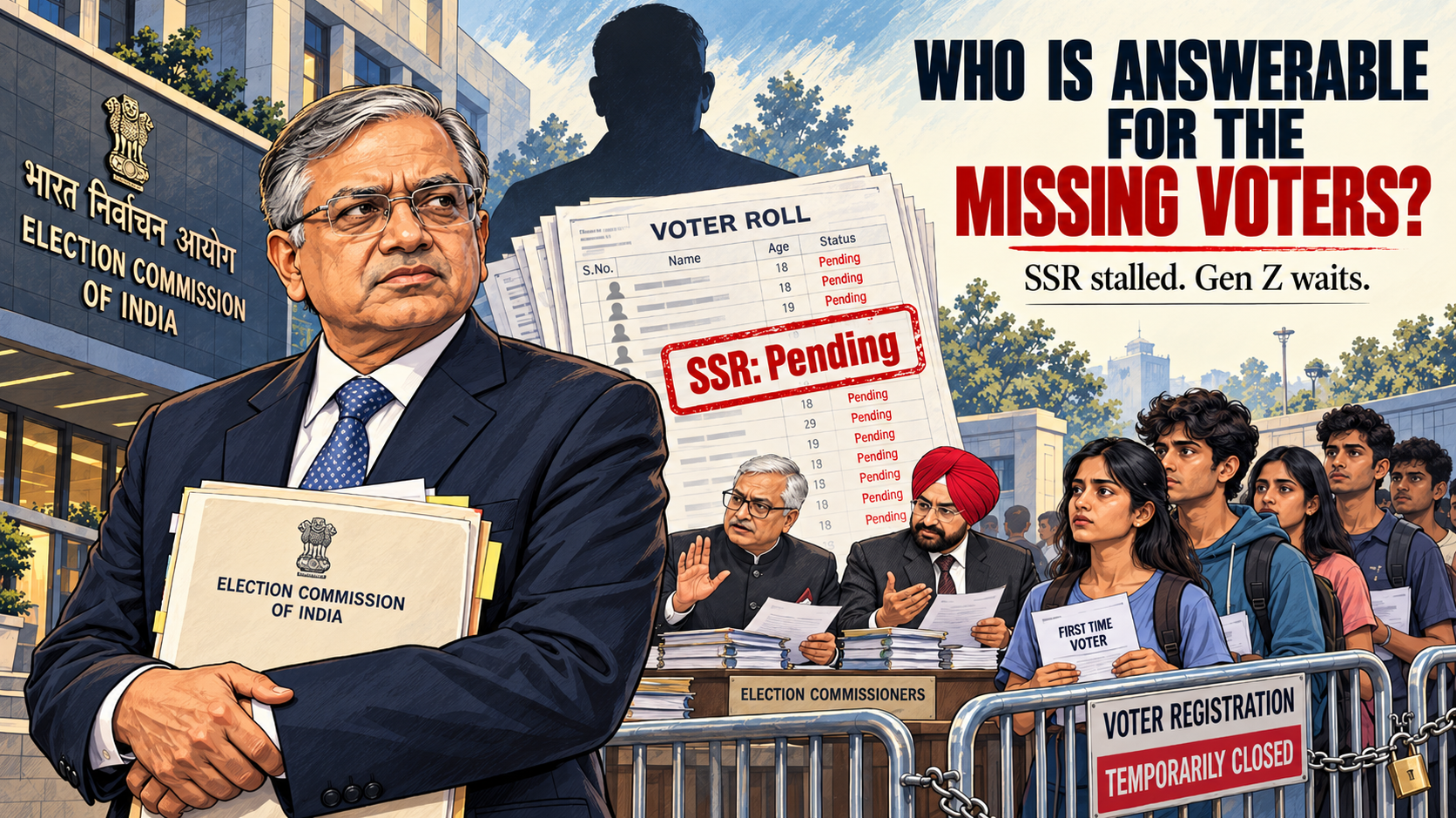
For an institution that repeatedly speaks about voter awareness,
electoral participation and the importance of young Indians joining democracy,
the Election Commission of India now faces a deeply uncomfortable question. Why
has one of the routine mechanisms meant to bring newly eligible 18-year-olds
onto the electoral rolls remained stalled after the 2024 cycle?
This is not merely an Opposition allegation. The Economic Times
reported that the annual Special Summary Revision, or SSR, has not been resumed
after the 2024 cycle. More seriously, Election Commissioners Sukhbir Singh
Sandhu and Vivek Joshi reportedly argued that the exercise should resume, while
Chief Election Commissioner Gyanesh Kumar sought legal advice on whether an SSR
was necessary while the Special Intensive Revision, or SIR, was under way.¹
That makes this much bigger than an administrative delay.
The Exercise Meant to Keep Democracy Open
The SSR is not some obscure clerical ritual buried inside Election
Commission files. It is part of the mechanism through which electoral rolls are
regularly updated, and newly eligible voters are brought into the system.
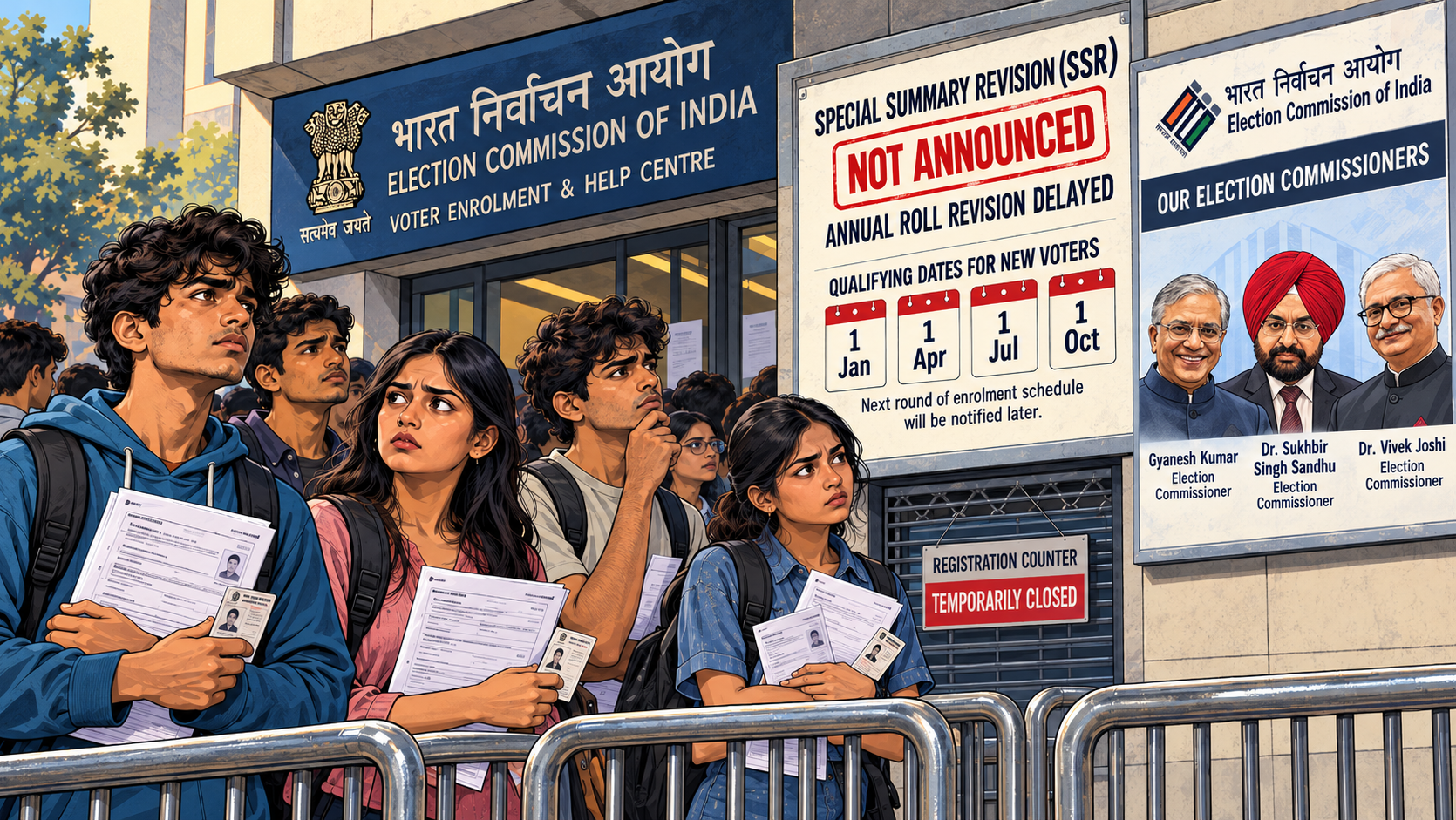
The process became particularly important after four qualifying dates
were introduced during the year: 1 January, 1 April, 1 July and 1 October. This
was specifically designed so that young citizens turning 18 did not have to
wait for the following January before becoming eligible for inclusion in the
electoral roll.²
The annual revision also serves a wider purpose. It updates electoral
rolls, allows claims and objections, helps correct discrepancies and prepares
cleaner rolls before elections. The Economic Times reports that an annual
revision has been part of the Commission's practice since 1958. Yet the
expected 2026-27 exercise has missed the usual May-June announcement period.¹
That should trouble anyone who takes electoral rights seriously.
The question is therefore not simply why a bureaucratic timetable
slipped. The question is why a system specifically designed to make enrolment
easier for new voters has been allowed to remain disrupted for so long.
Two Commissioners Wanted It Back
This is where the matter becomes far more disturbing.
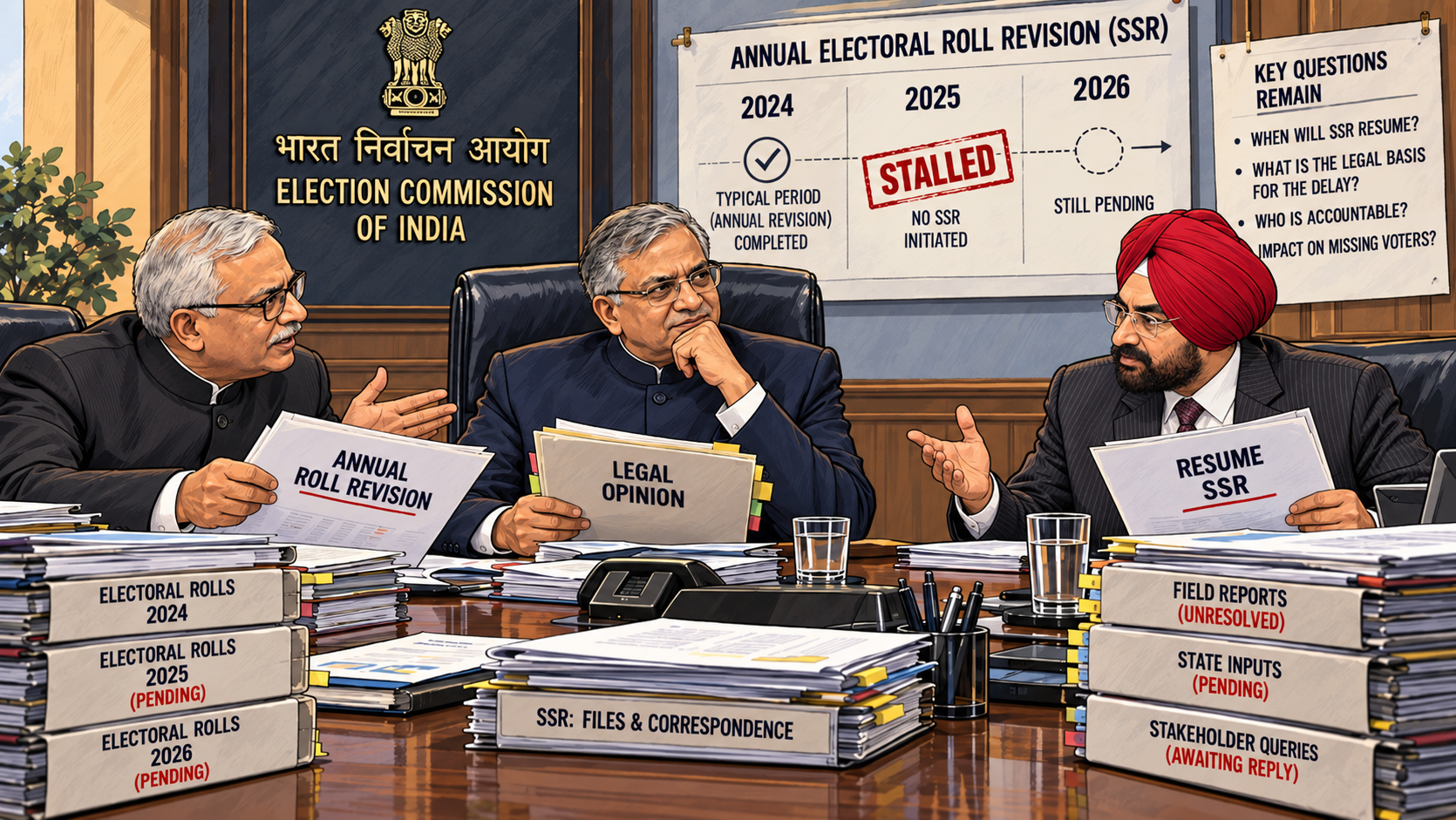
According to the Economic Times, Election Commissioners Sukhbir Singh
Sandhu and Vivek Joshi strongly advocated resuming the SSR. After legal advice
was obtained, they reportedly maintained that the annual revision was required
under the Commission's own electoral-roll framework and was particularly
necessary to ensure that citizens turning 18 could be added.¹
Yet the exercise remained stalled.
The New Indian Express independently reported the same broad picture,
noting that the annual SSR has remained disrupted since January 2024 and that
Sandhu and Joshi favoured its resumption while Gyanesh Kumar sought legal
clarity.³
India Today also reported that no SSR was conducted after the 2024
cycle and that the two Election Commissioners had strongly advocated restarting
it.²
So this can no longer comfortably be dismissed as routine paperwork.
When two members of a three-member constitutional body reportedly
consider an exercise necessary, but that exercise nevertheless remains frozen,
citizens are entitled to ask what exactly is happening inside Nirvachan Sadan.
SIR Cannot Become a Permanent Excuse
The apparent explanation is that the Commission became occupied with
the Special Intensive Revision process.
But SIR and SSR are not identical exercises.
SIR is a much more intensive revision of electoral rolls. SSR is the
familiar annual process through which rolls are updated, and newly eligible
citizens are routinely incorporated. India Today reported that the continuing
SIR process resulted in a break from the long-standing annual SSR convention.²
The Hindi commentary supplied for this article makes this distinction
its central criticism, arguing that an extraordinary revision process cannot
logically become a reason for indefinitely suspending the ordinary mechanism
through which newly eligible voters are routinely brought onto the rolls.
The rhetoric of that commentary goes considerably further than the
published evidence, including allegations of a deliberate political conspiracy.
Those allegations are not established by the material reviewed here. But the
factual question beneath the rhetoric is legitimate: why should an
extraordinary exercise displace a routine electoral safeguard for years?
The Election Commission should answer that plainly.
The Contradiction Is Becoming Difficult to Ignore
There is an obvious contradiction in publicly encouraging young Indians
to value democracy while the Commission's established annual machinery for
incorporating young voters remains disrupted.
The irony becomes sharper because the SSR was deliberately structured
around multiple qualifying dates precisely to reduce delays in registering
young citizens.
If an 18-year-old is repeatedly told that his or her vote matters, the
institution saying so must also ensure that the machinery for exercising that
vote works properly.
Public outreach cannot substitute for an electoral roll.
Speeches about participation cannot substitute for enrolment.
And voter-awareness campaigns cannot answer why an annual process designed to facilitate participation has not been restored.
This Is Not the Only Sign of Trouble Inside the Commission
The controversy also does not exist in isolation.
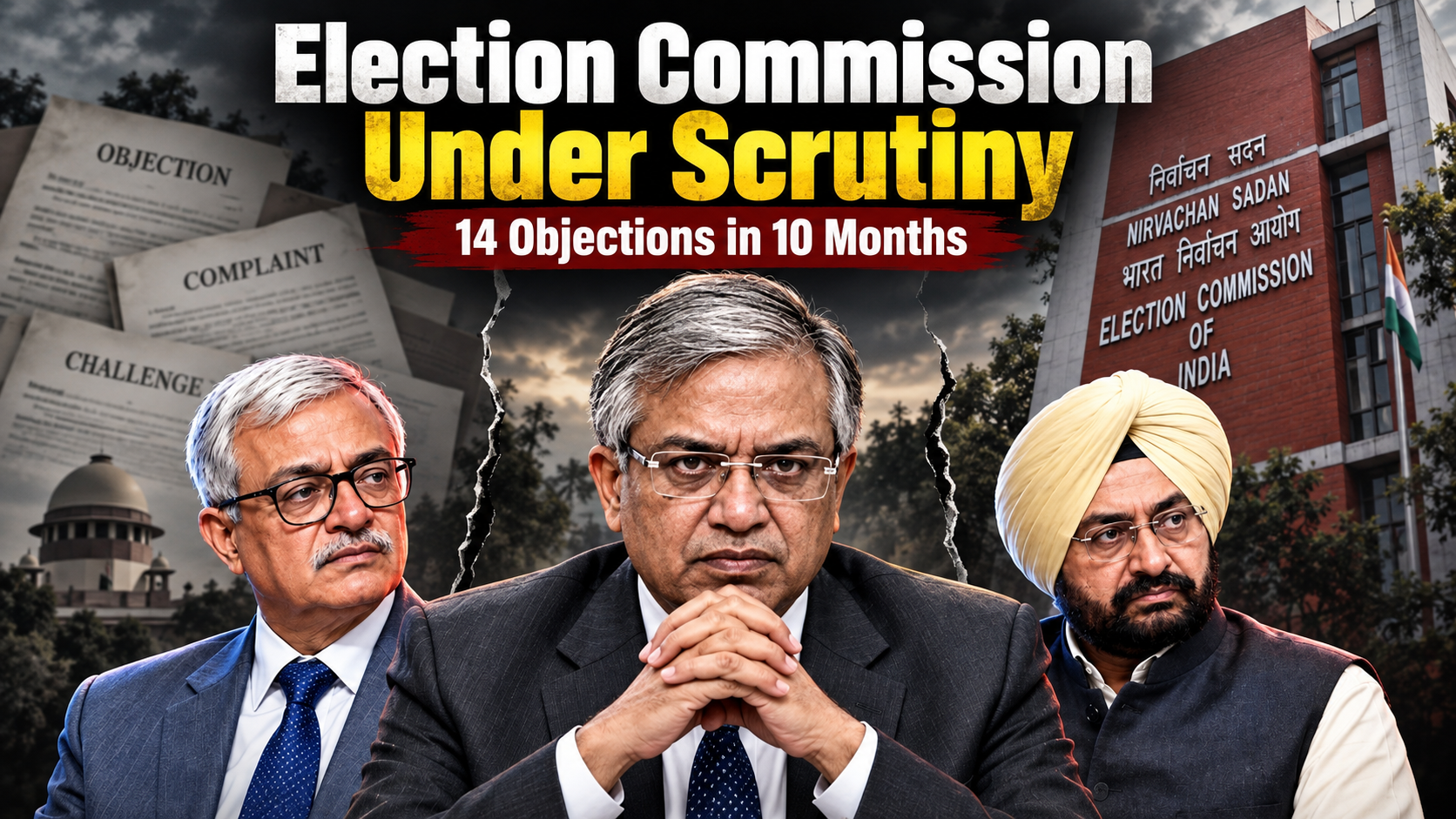
The New Indian Express and India Today both refer to another recent
investigation reporting that Sandhu and Joshi recorded objections on at least
14 occasions concerning decisions within the Election Commission over the
preceding ten months.³ ²
The Commission has responded to those reports by saying that differing
views are normal in institutional deliberations and that decisions were
ultimately unanimous.²
That response deserves to be placed on record.
But it does not settle the present question.
If two Election Commissioners wanted SSR restored, what prevented its
restoration? What was the precise legal advice sought by Gyanesh Kumar? What
did that advice say? Was there a formal Commission decision? Was there a vote?
Was the disagreement recorded? Who decided that SSR should remain suspended?
These are questions of institutional accountability, not partisan
curiosity.
And Then Comes the Question Nobody Should Have to Ask
The most damaging aspect of the controversy may eventually be the
appearance it creates.
A Chief Election Commissioner should never appear so insulated from
explanation that citizens begin wondering whether some unseen political or
institutional protection allows him to ignore criticism, internal disagreement
or public scrutiny.
There is presently no evidence in the reports reviewed here identifying
any "bigshot" protecting Gyanesh Kumar, and it would be irresponsible
to present such a claim as fact. Congress leaders have alleged collusion
between the government and the CEC, but that remains a political allegation,
not a demonstrated conclusion.²
Yet institutions also have to understand something about public trust.
When unexplained decisions repeatedly survive without transparent answers,
people naturally begin looking beyond the visible office-holder and asking who
gives him such confidence.
That is exactly why transparency is indispensable.
If there is no political instruction, publish the institutional
reasoning.
If legal advice justified the delay, disclose its substance.
If the full Commission formally decided against restarting SSR,
disclose the decision and the recorded reasoning of all three Commissioners.
Transparency could answer speculation far more effectively than another
press statement.
Gyanesh Kumar Owes the Country an Explanation
The Election Commission's first responsibility is not to the
government, the Opposition, political parties or television studios. It is to
the integrity of India's electoral process.
An eligible citizen should not have to wonder whether an administrative
stand-off inside the Election Commission will determine whether his or her name
appears on the electoral roll.
The matter becomes particularly urgent with Assembly elections
approaching in states including Uttar Pradesh and Goa. The Economic Times
specifically noted the significance of conducting SSR in election-bound states
and reported that UP and Goa had completed SIR yet were still awaiting the
annual revision ahead of the 2027 elections.¹
The Election Commission therefore needs to stop treating this as an
internal procedural disagreement.
It must explain why the annual revision stopped, why it was not
restored after the other Commissioners reportedly pressed for it, what legal
obstacle remains, and when the normal process will resume.
And Gyanesh Kumar, as Chief Election Commissioner, must answer the most
basic question of all.
If two of his fellow Commissioners reportedly wanted the annual
revision restored, why is it still not happening?
Until that question receives a clear, documented and convincing answer,
every speech about encouraging young Indians to participate in democracy will
carry an uncomfortable contradiction.
The country does not need another lecture on the importance of voting.
It needs an Election Commission that makes sure every eligible Indian
can actually vote.
References
1. The
Economic Times, “Gen Z voting rights on hold as special summary revision
stays stalled since January 2024”, 24 September 2026.
Read
The Economic Times report
2. India
Today, “Report flags pause in Gen Z voter enrolment, Congress alleges
Modi-CEC conspiracy”, 25 September 2026.
Read
the India Today report
3. The New
Indian Express, “Gen Z voters in limbo as ECI’s annual roll revision
remains stalled”, 25 September 2026.
Read
The New Indian Express report
4. The Wire,
“Gen Zs Not Being Included in Voter List Since 2024 Despite Two Election
Commissioners Asking for It: Report”.
Read
The Wire report
Ask Arka about what you just read
Ask for a summary, clarification, the evidence behind an argument, or more writing by Anindya on the same subject.

Discussion