In this article
- First, Nobody Is Asking the Streets to Replace the Supreme Court
- The Anna Hazare Question That Cannot Be Avoided
- Courts Must Decide on Law, Not Applause. But That Does Not Make Public Opinion Irrelevant.
- The Ayodhya Judgment Must Not Be Misrepresented Either
- The Election Commission Is Independent. It Is Not Infallible.
- Fourteen Recorded Objections Cannot Be Dismissed With a Lecture About Institutional Respect
- Unanimity Is Not an Answer to Every Procedural Objection
- West Bengal: The Appeals Question Needs an Answer, Not Another Slogan
- What About States Where the Opposition Won?
- The Mahadevapura Example Shows Why Specificity Matters
- Close Elections Do Not Prove a Manipulation Model
- Salve's Own Position on Judicial Review Makes the Simplistic Defence Harder to Sustain
- The Difference Between Professional Advocacy and Public Intellectual Responsibility
- Is Harish Salve Biased?
- A Larger BJP Contradiction
- Equidynamism: Institutions Need Authority, Citizens Need the Power to Question It
- Mr Salve, the Question Is Not Whether the Streets Should Rule. The Question Is Whether Institutions Should Answer.
By Anindya Nandi | 11 October 2026
There is a particular danger when a highly
respected lawyer uses the language of constitutionalism to defend a powerful
institution facing serious questions about its conduct. The danger is not that
the lawyer necessarily says something legally false. It is that a perfectly
correct legal principle may be presented so selectively that it creates an
entirely misleading picture of the controversy.
That is the problem with Harish Salve's recent
intervention in the debate surrounding the Election Commission of India.
Salve is no ordinary television commentator. He is
a senior advocate, a former Solicitor General of India and one of the country's
most recognisable legal minds. His words naturally carry authority. When
someone of his professional standing explains the Constitution to the public,
viewers are entitled to expect not merely technical accuracy, but intellectual
completeness.
In an interview broadcast by India Today on 6
October 2026, Salve warned against allowing constitutional disputes to be
settled through street pressure. He also emphasised the distinction between
observations made by judges during hearings and binding judicial decisions, the
collective character of the three-member Election Commission, and the power of
the Supreme Court to examine constitutional institutions.[1]
Some of those propositions are entirely correct.
That is precisely why they require careful
examination. A sound legal proposition can still be used to divert attention
from an uncomfortable factual question.
The central issue is not whether courts should
surrender to crowds. They should not. Nor is it whether the Election Commission
should be abolished because an opposition party dislikes an election result. It
should not.
The real question is whether the existence of
courts and constitutional institutions requires citizens to suspend their right
to protest, whether institutional independence can be invoked to avoid
answering documented allegations, and whether an experienced constitutional
lawyer is applying the same principles consistently.
On those questions, Salve's defence deserves a far
more searching examination than the deference ordinarily granted to his
professional stature.
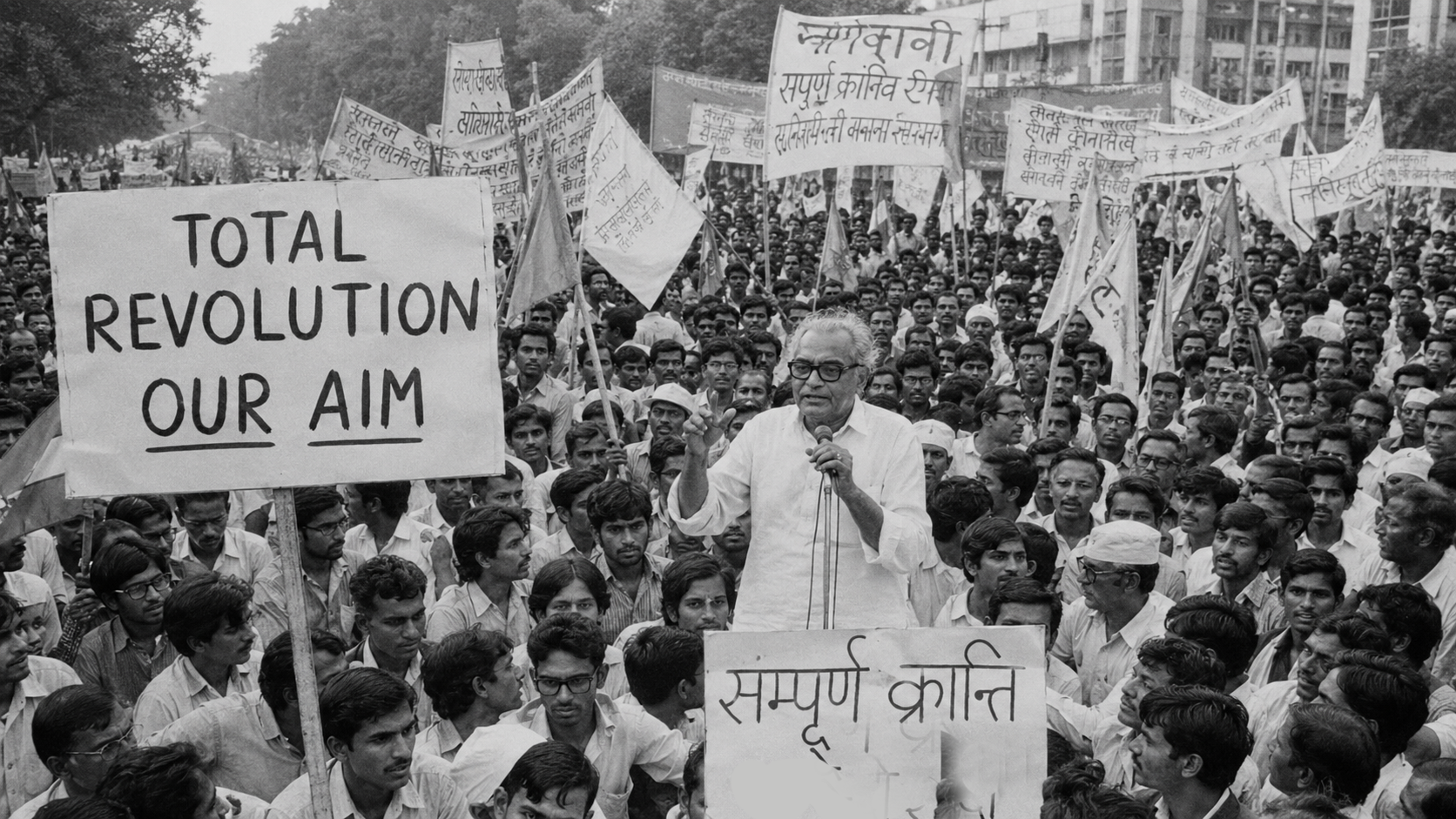
First, Nobody Is Asking the Streets to Replace the Supreme Court
Salve's most memorable formulation was that
constitutional disputes cannot be governed by the rule of the streets.
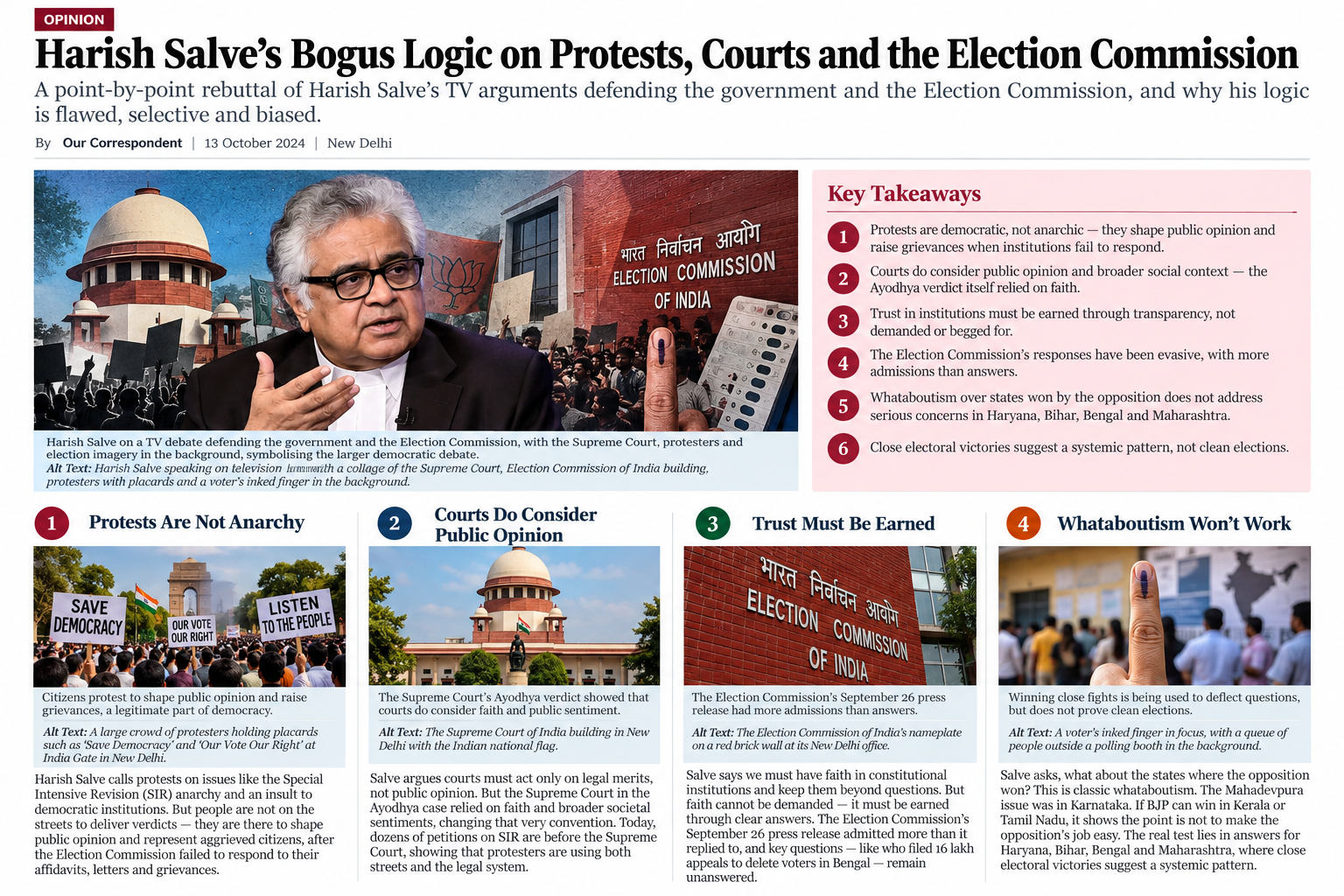
Taken literally, this is unexceptionable. Courts decide legal disputes. Elections determine who governs. Parliament legislates. Constitutional institutions exercise powers conferred upon them by law. A crowd cannot replace those processes merely by gathering in sufficient numbers.
But who has seriously argued otherwise?
The people protesting against the Election
Commission are not necessarily claiming that a gathering at Jantar Mantar can
issue a binding judicial decree or cancel an election. They are demanding
answers, expressing political dissatisfaction, mobilising public opinion and
seeking accountability for decisions that may affect the electoral rights of
millions.
Those are recognised functions of political
protest.
The Constitution does not limit public
participation to casting a vote once every few years and filing a petition when
something goes wrong. Article 19 protects freedom of expression and peaceful
assembly, subject to constitutionally permissible restrictions.
The Supreme Court recognised these freedoms in Mazdoor
Kisan Shakti Sangathan v. Union of India in 2018. The Court also
acknowledged the rights of residents and commuters affected by demonstrations,
requiring accommodation between competing interests rather than the automatic
extinction of one right.[2]
That is the important distinction Salve's
formulation risks obscuring.
A protest can be politically legitimate without
being legally decisive.
A court case can be legally necessary without being
the only legitimate form of democratic participation.
And the same citizens can pursue both avenues
simultaneously.
Indeed, litigation concerning the Special Intensive
Revision, the conduct of the Election Commission and the appointment framework
for Election Commissioners is already before judicial institutions. Public
demonstrations have taken place alongside those proceedings, not necessarily in
substitution for them.
To describe such mobilisation simply as an attempt
to impose the rule of the streets is to confuse public pressure with legal
adjudication.
The distinction is elementary. It should be
especially familiar to a lawyer of Salve's experience.
The Anna Hazare Question That Cannot Be Avoided
India has already witnessed a major national
movement that used public mobilisation to demand institutional reform.
The India Against Corruption movement and Anna
Hazare's protests in 2011 brought large crowds into public spaces. The campaign
demanded a stronger anti-corruption framework and sought to influence
legislative and governmental decisions.
It did not possess the authority to enact a law.
Yet its participants believed that public pressure
was a legitimate way to demand one.
The BJP, then in opposition, politically supported
important aspects of the anti-corruption mobilisation and used corruption
allegations against the Congress-led government as a central political
argument.
There was nothing inherently unconstitutional about
that.
A government may be challenged through peaceful
mass mobilisation. That remains true even when the protest is politically
organised, its rhetoric is severe or its demands are unacceptable to those in
power.
Now consider the present controversy.
Citizens are demanding accountability from an
Election Commission facing documented internal objections, disputed
electoral-roll decisions and judicial scrutiny.
If public mobilisation was a legitimate instrument
for demanding anti-corruption accountability under a Congress-led government,
why should comparable mobilisation demanding electoral accountability under a
BJP-led government be dismissed as anarchy?
The two movements are not identical. Their
organisers, objectives, scale and legal circumstances differ.
But the constitutional principle cannot depend on
the identity of the ruling party.
If Salve's argument is simply that protesters must
not use violence or dictate court judgments, he is right.
If the practical message is that citizens should
abandon public mobilisation because a constitutional institution is involved,
the argument becomes indefensible.
The Constitution does not create one standard of
protest for opposition to Congress and another for opposition to the BJP.
Courts Must Decide on Law, Not Applause. But That Does Not Make Public Opinion Irrelevant.
Another argument attributed to Salve in the
supplied commentary is that courts should decide cases on legal merit rather
than public sentiment.
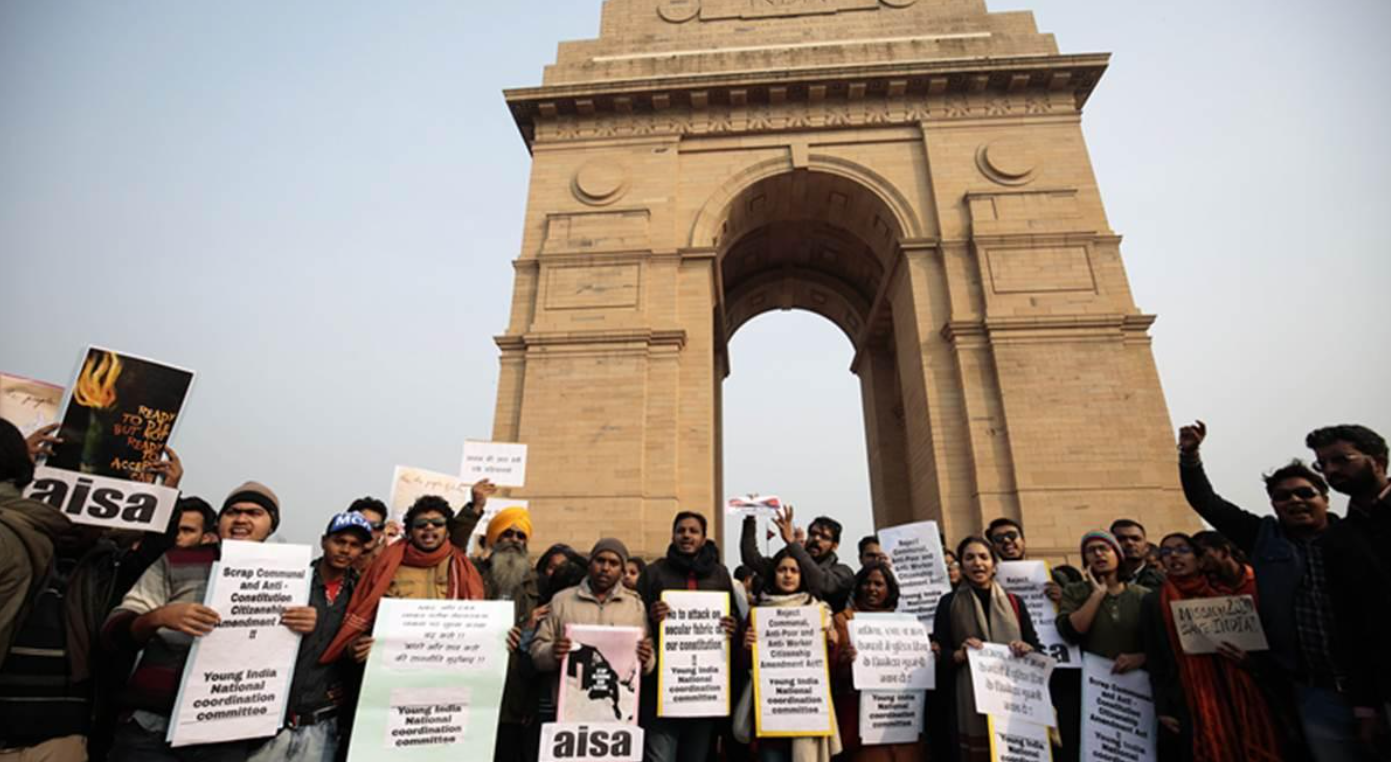
As a principle of judicial adjudication, that is
correct.
Judges cannot determine the legality of an
electoral-roll deletion by counting how many protesters gather outside the
courthouse. A constitutional violation does not become lawful because the government
is popular. Nor does a lawful administrative decision become unconstitutional
because an opposition movement attracts a large crowd.
Judicial independence requires precisely that
separation.
But public opinion and judicial adjudication
perform different democratic functions.
Public opinion may bring a previously neglected
issue into public view. Investigative journalism may expose information that
leads to litigation. Political mobilisation may encourage affected citizens to
assert their rights. Courts then assess the evidence and applicable law.
There is no contradiction between these activities.
A lawyer who insists that courts must decide
according to law is stating a necessary principle. A commentator who uses that
principle to suggest that public mobilisation is illegitimate is making an
entirely different argument.
The first is constitutionally sound.
The second does not follow from it.
The Ayodhya Judgment Must Not Be Misrepresented Either
The supplied critique invokes the Supreme Court's
2019 Ayodhya judgment and argues that the Court had already departed from
purely legal reasoning by deciding on faith.
This criticism needs refinement.
The Ayodhya judgment acknowledged the religious
beliefs of the parties and considered historical, documentary, archaeological
and possessory evidence. It also addressed the legal character of competing
claims to the disputed site.
The judgment did not simply announce that one
community's faith automatically prevailed over another community's legal
rights.
Indeed, the Court recognised the illegality of the
mosque's demolition and provided for an alternative site for a mosque.
One may critically examine whether the Court's
ultimate allocation of relief was fully consistent with its findings about
unlawful conduct, possession and the treatment of competing claims. That is a
serious jurisprudential question.
But describing the entire decision as nothing more
than a verdict based on faith would be inaccurate.
There is a stronger argument available.
The Ayodhya judgment demonstrates that
constitutional and civil adjudication may involve questions deeply embedded in
public history, religious belief and social conflict. Courts must resolve those
questions through law even when society is passionately divided.
The existence of public sentiment does not deprive
the court of jurisdiction.
Equally, the court's jurisdiction does not
extinguish the public's freedom to debate the issue.
Salve is right that legal outcomes cannot be
dictated by public applause. He would be wrong if that proposition were used to
demand political silence outside the courtroom.
The Election Commission Is Independent. It Is Not Infallible.
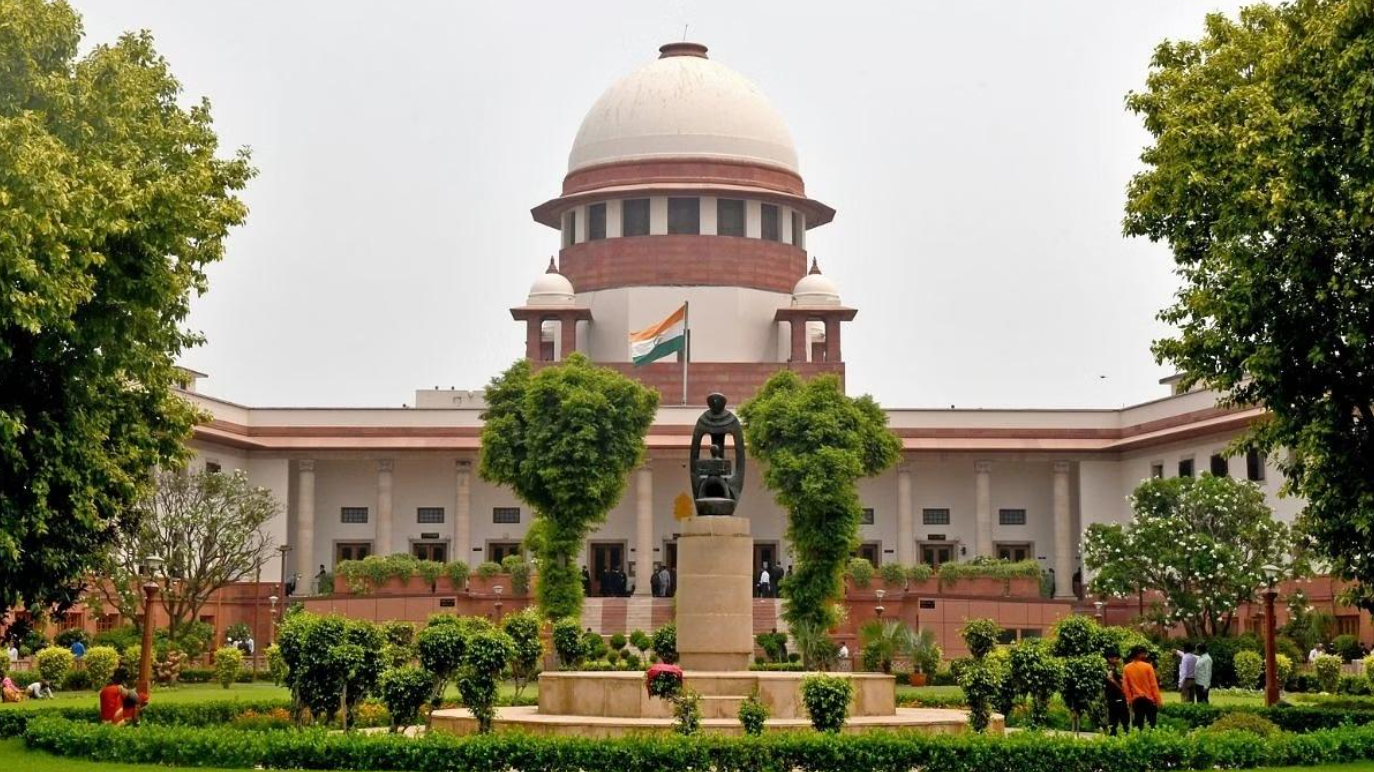
The most troubling feature of the institutional-defence argument is the assumption that questioning a constitutional body somehow weakens the constitutional system itself.
This reverses the relationship between institutions
and accountability.
The Election Commission derives its authority from
the Constitution. It does not derive that authority from a requirement that
citizens trust every decision without examination.
Article 324 gives the Commission substantial
responsibility for the superintendence, direction and control of elections.
That responsibility is exceptionally important
because electoral administration affects the legitimacy of every elected
government.
Precisely because the Commission's authority is so
extensive, transparency and procedural integrity are essential.
Institutional independence means that the
Commission should not be controlled by the government or political parties in
the discharge of its constitutional duties.
It does not mean that the Commission is beyond
judicial review, legislative scrutiny, investigative journalism or peaceful
public criticism.
A constitutional institution does not become weaker
when it answers a legitimate question.
It becomes weaker when the public begins to suspect
that it cannot answer one.
Fourteen Recorded Objections Cannot Be Dismissed With a Lecture About Institutional Respect
The controversy is not based solely on opposition
speeches.
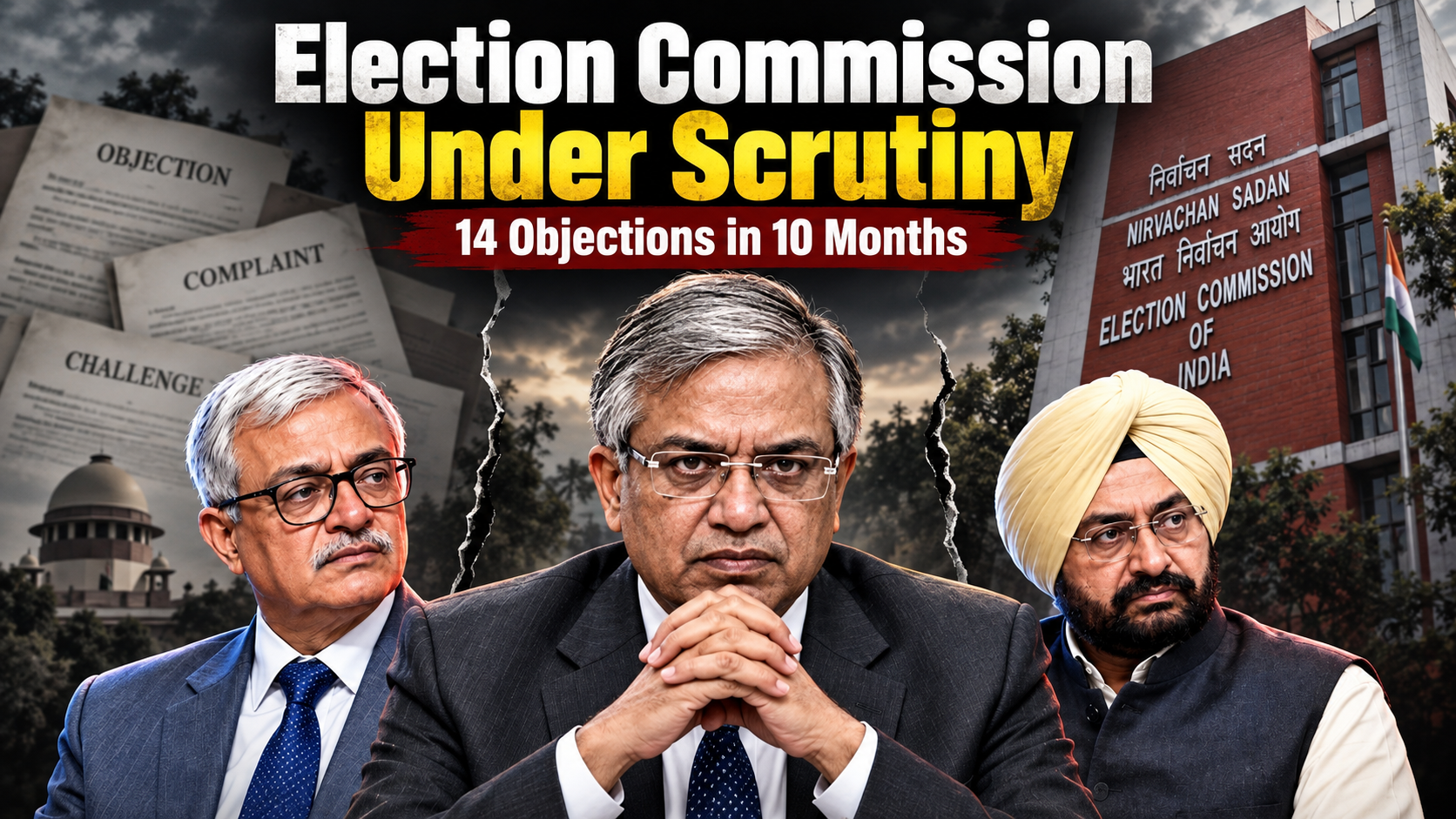
An investigation published by The Indian Express in
September 2026 reported that Election Commissioners Sukhbir Singh Sandhu and
Vivek Joshi had placed objections on record at least fourteen times over
approximately ten months.
The reported objections concerned consequential
administrative matters, including changes to Form 6, access to electoral-roll
software, allocation of administrative responsibilities and appeals concerning
electoral-roll decisions in West Bengal.[3]
These are not minor questions of office etiquette.
They go directly to the procedures through which
voters are registered, electoral information is maintained and decisions are
authorised.
Consider Form 6.
The Express reported that Vivek Joshi recorded
concerns in May 2026 about altering the form without amending the relevant
rules. Sandhu reportedly concurred.
Nevertheless, the disputed declaration subsequently
appeared in the online process. Sandhu later described the change as
unauthorised or illegal and sought its removal.
That account is based on reported internal records.
The underlying legal question remains subject to appropriate examination, and a
commissioner's recorded opinion is not automatically a final judicial finding.
But it is certainly evidence of an issue requiring
an answer.
Who authorised the change?
Under what statutory or rule-making power?
Was the full Commission consulted?
If the change was valid, what was its legal basis?
If it was not valid, when was it corrected?
These questions cannot be answered by explaining
that the Election Commission is a respected constitutional institution.
Its constitutional status is the reason the
questions matter.
Unanimity Is Not an Answer to Every Procedural Objection
The Election Commission responded to the Express
investigation by describing internal observations and differing views as
ordinary parts of institutional deliberation.
It also asserted that the Commission's decisions
over the relevant period were unanimous.
That is an important response and should not be
suppressed.
A three-member institution can have vigorous
internal debate before reaching a unanimous final decision. There is nothing
inherently improper about disagreement during deliberation.
But the Express identified a separate difficulty.
Its reporting described situations in which two
Commissioners allegedly questioned actions already taken without their
knowledge or contrary to their recorded advice.
A final decision reached unanimously after proper
deliberation is one thing.
An administrative action allegedly implemented
before proper approval, followed by an institutional statement about general
unanimity, is another.
The distinction cannot be resolved through
terminology.
If the Commission maintains that the relevant
decisions were properly authorised, it should be able to identify the
decisions, dates, approving authority and legal basis, subject to legitimate
confidentiality requirements.
This is not an unreasonable demand.
It is the minimum documentation expected from an
institution administering the world's largest electorate.
The Commission's September response did not,
according to the Express, answer several of the specific questions raised by
its investigation.[4]
That omission does not prove criminal misconduct.
It does establish a serious gap between a general
institutional reassurance and a particular documented allegation.
West Bengal: The Appeals Question Needs an Answer, Not Another Slogan
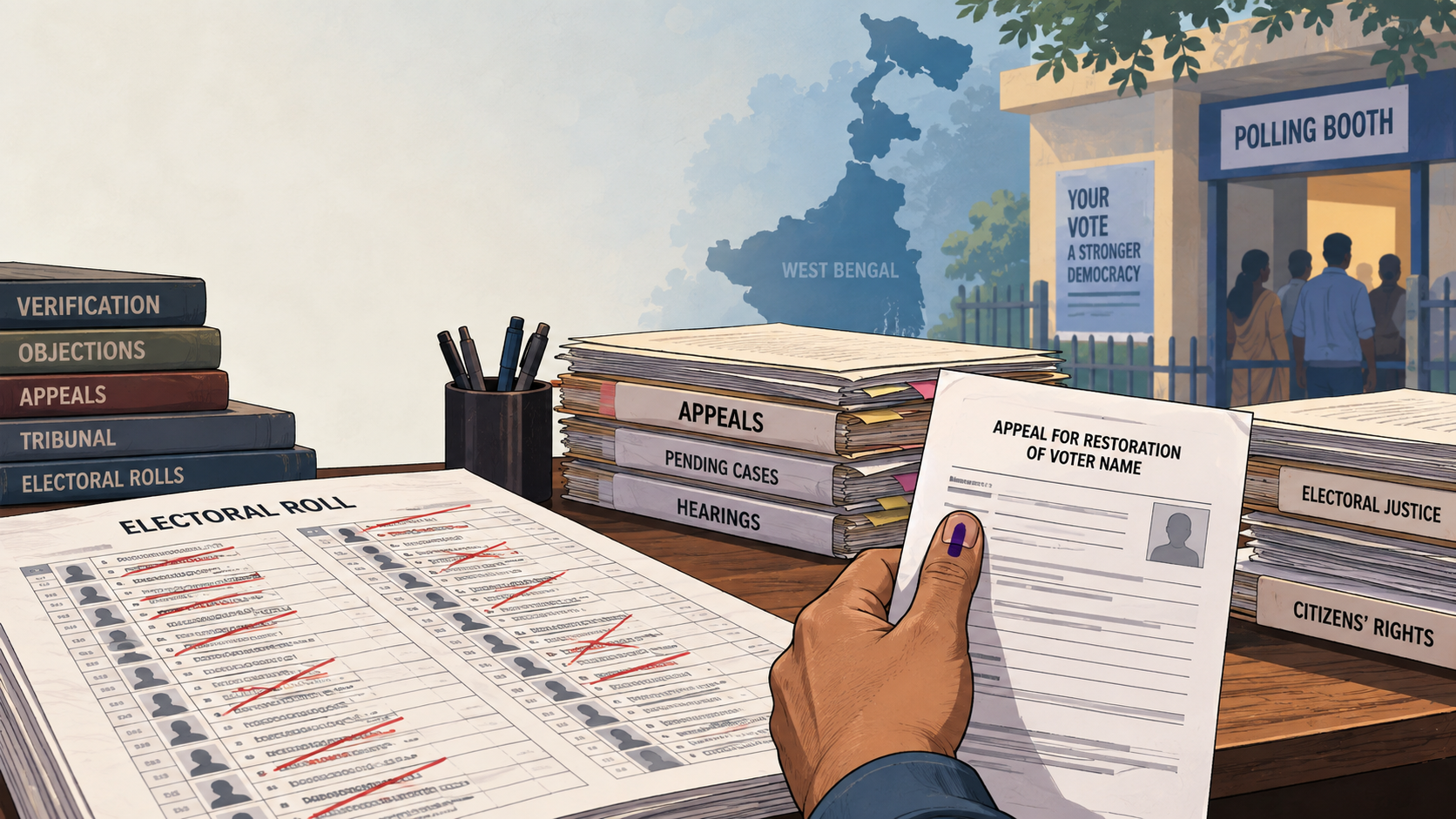
The West Bengal controversy is particularly
revealing because it concerns the identity and authority of those who initiated
electoral-roll appeals.
The supplied commentary refers to sixteen lakh
appeals. Other reporting describes appeals numbering in the lakhs without
establishing that every one of them sought the deletion of a voter.
Those formulations should not be treated as
interchangeable.
An appeal against restoration, an objection to
inclusion, an appeal against deletion and a successful removal are distinct
legal and administrative events.
The relevant questions are more precise.
How many appeals were filed?
Under which statutory provisions?
Who filed or authorised them?
Were they filed by legally entitled persons or
authorities?
How many were directed against restoration of
voters?
How many succeeded?
How many affected eligible voters?
Were the procedures followed in each case?
The Express reported that the two Election
Commissioners questioned who had authorised large numbers of appeals concerning
restored voters in West Bengal.
That is a specific institutional issue.
A general statement that the Election Commission
acts independently does not answer it.
Nor would a political assertion that every such
appeal was fraudulent.
The correct demand is disclosure, examination and
accountability.
When a citizen's name is at risk of being excluded
from an electoral roll, procedure is not a technical luxury.
Procedure is part of the protection of the
franchise.
What About States Where the Opposition Won?
One of the more familiar arguments in political
debates about electoral integrity is that opposition victories supposedly
disprove allegations of institutional bias.
The logic is weak.
A system can produce correct outcomes in many
places and still contain serious irregularities in others.
A bank does not establish that every transaction
was properly authorised by demonstrating that most transactions were genuine.
An examination authority does not disprove a
particular paper leak by pointing to thousands of students who passed honestly.
An electoral institution cannot conclusively answer
an allegation concerning one constituency by identifying another constituency
where the opposition won.
The relevant unit of examination is the alleged
irregularity.
If the allegation concerns a particular electoral
roll, the evidence must concern that roll.
If it concerns an unauthorised software
modification, the evidence must concern the modification.
If it concerns a constituency-level deletion, the
evidence must establish whether the deletion was lawful and whether the
affected person was eligible.
This does not mean that opposition victories are
irrelevant.
They may weaken an extravagant allegation that the
entire national electoral system is uniformly programmed to produce BJP
victories.
They may also be relevant when assessing a proposed
mechanism of systematic manipulation.
But they do not logically disprove a specific
allegation about a different place or process.
That is why the response must be proportional to
the claim.
A sweeping conspiracy allegation requires sweeping
evidence.
A specific procedural allegation requires a
specific procedural answer.
Pointing to an opposition victory in another state
is not a substitute for either.
The Mahadevapura Example Shows Why Specificity Matters
The controversy concerning Mahadevapura in
Karnataka has been invoked in wider political allegations about electoral-roll
integrity.
Its significance for the present argument is
methodological.
A complaint about particular entries, addresses,
forms or administrative processes must be tested against the corresponding
records.
Whether the BJP won or lost elsewhere does not
establish whether the disputed entries in Mahadevapura were genuine.
Equally, the discovery of suspicious-looking
entries does not automatically establish that votes were illegally cast, that
an election result changed or that a political party directed the irregularity.
Each proposition requires additional evidence.
This is where serious electoral criticism must
distinguish itself from political storytelling.
The objective should be to reconstruct the
administrative process, identify departures from law, quantify any actual
effect and establish responsibility where the evidence permits.
A legal defence that avoids those questions is
inadequate.
An accusation that skips those questions is
inadequate too.
Close Elections Do Not Prove a Manipulation Model
The supplied commentary suggests that a system
designed to manipulate elections might concentrate on closely contested seats.
As a hypothesis, that is intelligible.
If someone were attempting to alter electoral
outcomes through targeted interference, marginal constituencies might appear
more consequential than seats with overwhelming majorities.
But plausibility is not proof.
Close electoral contests are normal in competitive
democracies.
A narrow victory does not establish that the winner
benefited from fraudulent electoral-roll changes.
Nor does a pattern of narrow victories, without
more, demonstrate a coordinated manipulation scheme.
Testing such a hypothesis would require
constituency-level information about registration, deletion, restoration,
turnout, the timing of changes and the legal validity of affected entries.
Even then, proving an administrative irregularity
would be distinct from proving partisan intent or a changed electoral result.
This distinction protects the credibility of
criticism.
If we demand rigorous evidence from the Election
Commission, we must demand the same from those accusing it.
There is no intellectual honour in replacing one
selective narrative with another.
Salve's Own Position on Judicial Review Makes the Simplistic Defence Harder to Sustain
There is an important detail in Salve's interview
that critics should acknowledge.
According to India Today's published account, he
recognised the Supreme Court's broad powers to examine the legality of actions
taken by constitutional institutions.
He also recognised that the Election Commission is
a three-member body and that institutional decisions involve collective
responsibility.
These observations do not support the claim that
Salve believes the Commission is literally beyond judicial scrutiny.
It would therefore be unfair to attribute that
absolute position to him.
But his acknowledgement creates a further question.
If judicial scrutiny is legitimate, if decisions
must be collectively authorised and if institutional actions must comply with
law, why should public criticism of possible departures from those requirements
be treated as a threat to constitutional order?
The existence of judicial review is not an argument
against citizens demanding that judicial review take place.
Nor does collective responsibility answer an
allegation that the collective process itself may have been bypassed.
An experienced lawyer should be able to distinguish
the principle of institutional independence from the factual question of
whether a particular decision was lawfully taken.
The Commission's independence deserves protection.
Its actions deserve examination.
Those two propositions reinforce rather than
contradict one another.
The Difference Between Professional Advocacy and Public Intellectual Responsibility
Harish Salve is entitled to his political opinions.
He is entitled to defend the Election Commission's
legal position.
He is entitled to argue that opposition allegations
are exaggerated, that protesters have misunderstood the law or that particular
administrative decisions were valid.
A lawyer does not surrender freedom of expression
because he possesses professional distinction.
But there is a difference between presenting a
client's best legal case and appearing before the public as an authoritative
interpreter of a national constitutional controversy.
Professional advocacy is necessarily selective.
Counsel advances arguments favourable to the position being represented while
remaining bound by professional duties.
Public constitutional commentary invites a broader
expectation.
When a prominent lawyer appears on television to
explain why protesters are wrong, the audience is entitled to ask whether he
has also addressed the strongest evidence supporting their concerns.
In this controversy, that evidence includes the
reported objections of two Election Commissioners, the disputed Form 6 changes,
questions about software access and the unresolved authorisation of appeals.
A defence that discusses the sanctity of
institutions while leaving these issues largely unexplained may be legally
sophisticated but analytically incomplete.
That incompleteness is what deserves criticism.
Is Harish Salve Biased?
The word bias can describe a demonstrable
pattern of selective reasoning. It can also imply an undisclosed personal
motive, improper influence or corrupt relationship. Those are not equivalent
allegations.
His emphasis on the danger of street pressure gives
prominence to one democratic risk while potentially understating another: the
risk that citizens may be unable to secure meaningful answers from an
institution whose conduct is being questioned.
His focus on collective institutional
responsibility is relevant, but it does not independently resolve reported
instances in which the collective process may have been bypassed.
And a defence based on the importance of respecting
institutions becomes unpersuasive if it does not confront the specific
documentary record.
These are identifiable asymmetries in the argument.
They justify describing the intervention as
institutionally protective and potentially favourable to the government's
political position.
They do not prove that Salve was paid to advance
the position, acted under instructions from the BJP or deliberately deceived
viewers.
There is no verified evidence in the material
examined that would justify those accusations.
The strongest criticism is therefore not that
Salve's motives have been conclusively exposed.
It is that his public reasoning, in this instance,
has not adequately met the evidentiary burden created by the controversy he
chose to address.
For a lawyer of his stature, that is a serious
criticism in itself.
A Larger BJP Contradiction
The BJP has long benefited from public
mobilisation, institutional criticism and challenges to governments in power.
Its political history includes participation in
movements against Congress governments, criticism of the Election Commission
when it considered such criticism justified, and support for campaigns
demanding institutional reform.
The legitimacy of those activities did not depend
on the BJP already holding office.
Yet contemporary criticism of the Election
Commission is frequently answered with accusations that protesters are
undermining democracy.
That reversal deserves attention.
The governing party cannot reasonably claim that
popular agitation was an expression of democracy when it challenged Congress,
but becomes an attack on democracy when it challenges the BJP.
Nor can it claim that criticism of institutions is
patriotic when made by its supporters but dangerous when made by its opponents.
There may be legitimate differences between
particular movements. Some may be peaceful and others violent. Some allegations
may be well supported and others baseless.
Those differences must be examined.
But the constitutional right to dissent cannot be
assigned according to party affiliation.
The more powerful a political party becomes, the
greater its responsibility to respect that principle.
A government with confidence in its institutions
should welcome an opportunity to demonstrate that the allegations against them
are unfounded.
It should not need public silence as a condition of
institutional respect.
Equidynamism: Institutions Need Authority, Citizens Need the Power to Question It
This controversy reveals a fundamental tension
between institutional stability and democratic accountability.
Without stable institutions, elections become
vulnerable to political pressure, administrative chaos and the arbitrary
demands of competing groups.
Without public accountability, those same
institutions can become insulated from scrutiny and gradually lose the trust on
which their legitimacy depends.
Equidynamism requires neither blind institutional
obedience nor permanent suspicion of every official action.
It requires a dynamic equilibrium.
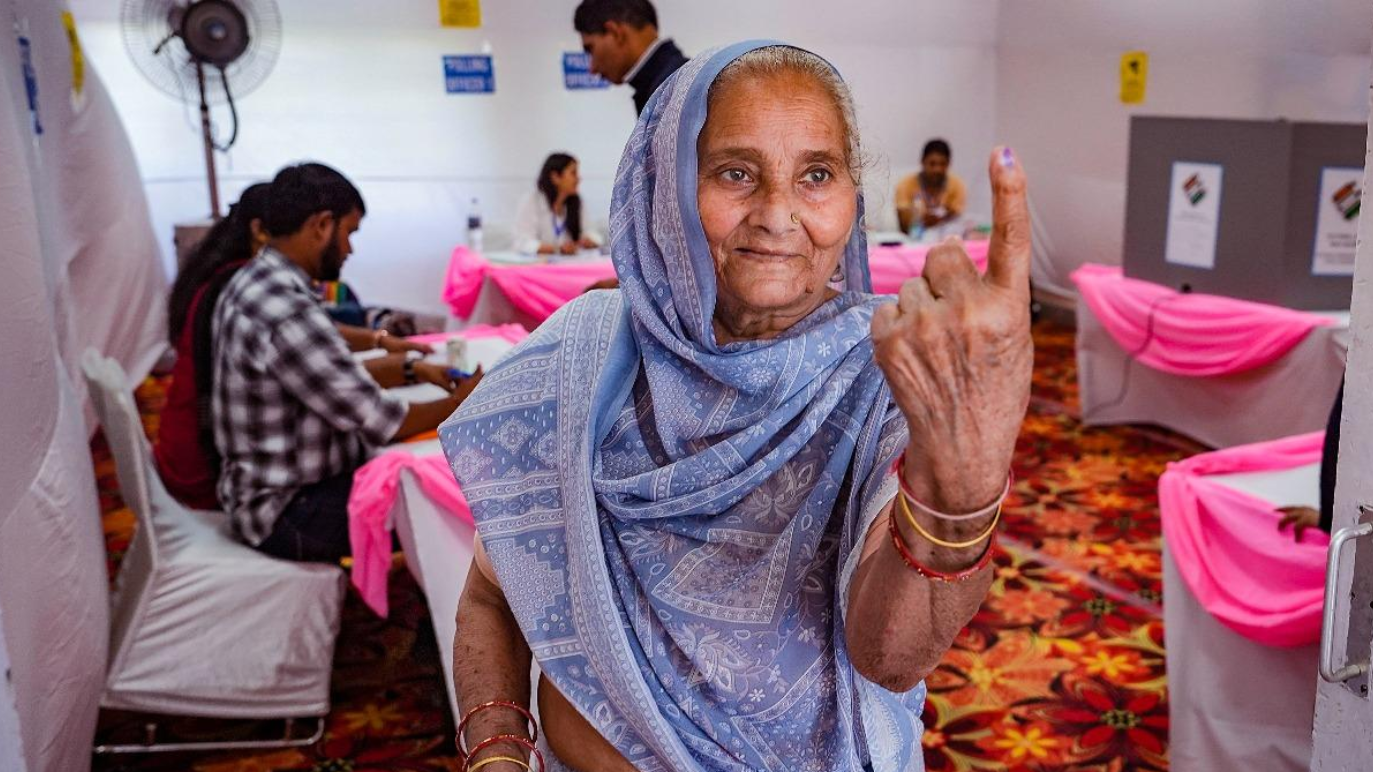
The Election Commission must be protected from improper political interference.
Citizens must be protected from arbitrary electoral
administration.
Courts must decide cases on evidence and law.
Citizens must remain free to debate, criticise and
peacefully mobilise around those cases.
Protesters must not intimidate judges or prevent
lawful institutional functions.
The government must not use public-order powers to
make legitimate dissent practically impossible.
These are not competing slogans requiring a
compromise halfway between truth and falsehood.
They are constitutional responsibilities that must
operate together.
When a credible allegation emerges, the correct
institutional response is not to demand confidence.
It is to produce the relevant records, explain the
legal authority, permit independent examination and correct any demonstrated
error.
Trust is an outcome of accountability.
It cannot be manufactured through the reputation of
a lawyer, however distinguished.
Mr Salve, the Question Is Not Whether the Streets Should Rule. The Question Is Whether Institutions Should Answer.
Harish Salve is right that courts must decide legal
disputes according to law.
He is right that judges' oral observations should
not be confused with binding judgments.
He is right that constitutional institutions
require independence and that no crowd should dictate their decisions.
None of these propositions answers the most
important questions in the present controversy.
Who authorised the disputed changes to Form 6?
What legal procedure supported those changes?
Why did two Election Commissioners record repeated
objections?
How were those objections resolved?
Who authorised the disputed appeals in West Bengal?
What independent examination has been conducted of
the electoral-roll software?
And why should the public accept a general
assurance of institutional integrity in place of specific answers to documented
concerns?
Those questions are not anarchic.
They are the questions an accountable
constitutional democracy should expect.
A distinguished lawyer's intellectual authority
should illuminate the distinction between lawful institutional independence and
immunity from scrutiny. It should not blur that distinction.
The people of India do not need another lecture
about respecting powerful institutions without examining how those institutions
exercise power.
They need transparency.
They need procedural fairness.
They need answers capable of surviving independent
scrutiny.
And they need the freedom to demand those answers
peacefully.
The streets cannot replace the Supreme Court.
But the Supreme Court was never intended to replace
the people's voice either.
Democracy is not the rule of the streets. Neither is it the rule of institutions that refuse to answer the people.
-------------------------------------------------------------------------------------------------------------------
Evidence and source notes
The article uses numbered source references. The following links are
the research foundation for publication.
1. India
Today, 6 October 2026: Harish Salve, It Can't Be the Rule of the Streets.
This is the verified published account of his interview, including his comments
on street pressure, judicial orders, collective responsibility and judicial
review.
2. Supreme Court:
Mazdoor Kisan Shakti Sangathan v. Union of India, 23 July 2018. Primary
judgment recognising peaceful assembly and the need to balance protesters'
rights with those of residents.
3. The
Indian Express: ECI responds to Commissioners' objections. Details the
fourteen recorded objections and the Commission's explanation of unanimity.
4. Reuters,
26 September 2026: Election Commission orders review of voter-roll changes.
Important subsequent development: the Commission announced a review of
electoral-roll software, which should be acknowledged rather than omitted.
5. The
Indian Express: Historical precedents for disagreements within the Election
Commission. Provides context for institutional dissent under earlier
Commissioners.
6. Supreme
Court of India: Ayodhya judgment, 9 November 2019. Primary judicial source
for the discussion of faith, evidence and relief.
7. Reuters,
6 October 2026: Police break up opposition protest demanding election chief's
resignation. Confirms the wider context of protests and the disputed
allegations.
8. Reuters, 11 October 2026: Delhi faces a second day of electoral protests. Confirms that the controversy and demonstrations remain current.
Ask Arka about what you just read
Ask for a summary, clarification, the evidence behind an argument, or more writing by Anindya on the same subject.

Discussion